What Makes Small Business Tax Prep Expensive in 2026? Cleanup, Catch-Up Bookkeeping, and Business Complexity

When owners ask why small business tax prep is so expensive, they usually focus on the tax return itself.
But for many accounting firms, the return is not the part that destroys margin. The real cost comes from everything that has to happen before the preparer can trust the return:
- catch-up bookkeeping,
- account reconciliation,
- transaction categorization,
- chart-of-accounts cleanup,
- missing-document follow-up,
- and reviewer time spent fixing an avoidable backlog.
This is the gap Wesley is built to close for firms.
The short version: expensive tax prep usually means expensive pre-tax bookkeeping
If the books are current and credible, the return is dramatically easier.
If the client shows up with:
- 12 months of bank statements,
- uncategorized transactions,
- unclear owner activity,
- duplicate vendors,
- and unresolved balance-sheet accounts,
then the engagement has quietly become a cleanup project before it ever becomes a tax project.
Coverage and resources
Open the authority pages that support this workflow.
Client Document Request Template for Bookkeeping Firms
A reusable client document request template for bookkeepers and accounting firms who need statements, receipts, and exception support without a vague back-and-forth.
Open page →
Uncategorized Transaction Follow-Up Template
A clean follow-up template for asking clients about uncategorized transactions, owner activity, unusual transfers, and missing memo detail without wasting reviewer time.
Open page →
Template library
Browse copyable SOPs, client messages, and bookkeeping checklists.
Open page →
The 2026 cost drivers that actually move the quote
| Cost driver | What it creates for the firm | Typical fee impact |
|---|---|---|
| 6-12 months behind | catch-up bookkeeping project before tax prep | +$750-$3,500+ |
| multiple bank and credit-card accounts | more reconciliations, transfers, and review | +$250-$1,500 |
| high transaction count | more categorization and more exception handling | +$500-$2,500 |
| inventory, payroll, or sales tax | more accounts and higher review sensitivity | +$500-$3,000 |
| missing source documents | client chasing, stalled review, rework | +$250-$1,500 |
| owner draws, reimbursements, or partner activity | equity cleanup and tax-sensitive review | +$500-$3,000 |
These are directional bands, but the pattern is consistent: messy books make tax prep expensive because cleanup labor is expensive.
Current market signals show the same thing
The adjacent market is already pricing around cleanup burden:
- QuickBooks Live Cleanup currently advertises a one-time cleanup starting at $150/month as a one-time fee and notes that pricing varies by the number of months needed.
- QuickBooks also says cleanup typically takes about 30 days once the required documents are uploaded.
- QuickBooks' own Live Bookkeeping pricing details note an initial $500 cleanup fee before ongoing monthly service tiers.
- Bench currently advertises bookkeeping plans starting at $189/month billed annually or $199/month billed monthly, and bookkeeping plus tax starting at $599/month billed annually or $699/month billed monthly.
- A current 2026 guide from Monaco CPA puts small-business bookkeeping cleanup projects in a $750-$3,500 range.
Those data points all point to the same conclusion: the market is already charging for cleanup. The only real question is whether your firm handles that work reactively and manually, or with a system designed to compress it.
Why “book quality” changes the quote more than revenue
Firms often discover this the hard way:
- a $400,000 business with mixed accounts can be more expensive than a $1.5 million business with clean books,
- a simple Schedule C can take longer than an S corp if the records are disorganized,
- a low-revenue ecommerce brand can still be expensive because of platform settlements and sales tax complexity.
In other words, revenue is an incomplete pricing input. A better mental model is:
tax prep cost = return complexity + book quality + cleanup backlog + client responsiveness
That is also why pricing disputes happen. The owner thinks they are paying for “a tax return,” but the firm is spending hours on preparation for the preparation.
What cleanup actually includes before the tax return starts
Most owners underestimate what a firm has to resolve before filing:
- confirm which accounts are active,
- build or repair the chart of accounts,
- reconcile bank and credit-card statements,
- identify transfers and duplicates,
- classify expenses consistently,
- resolve uncategorized or ambiguous merchant activity,
- validate P&L totals,
- validate balance-sheet accounts,
- chase missing context from the client.
If you are doing all of that in a spreadsheet, email, and accounting software side by side, the firm usually loses time and margin.
How Wesley changes the cost curve before review
This is where Wesley matters from a positioning standpoint.
Wesley is not just another SMB bookkeeping subscription. It is built for the accounting-firm moment where the client arrives late and the firm still has to produce a tax-ready first pass quickly.
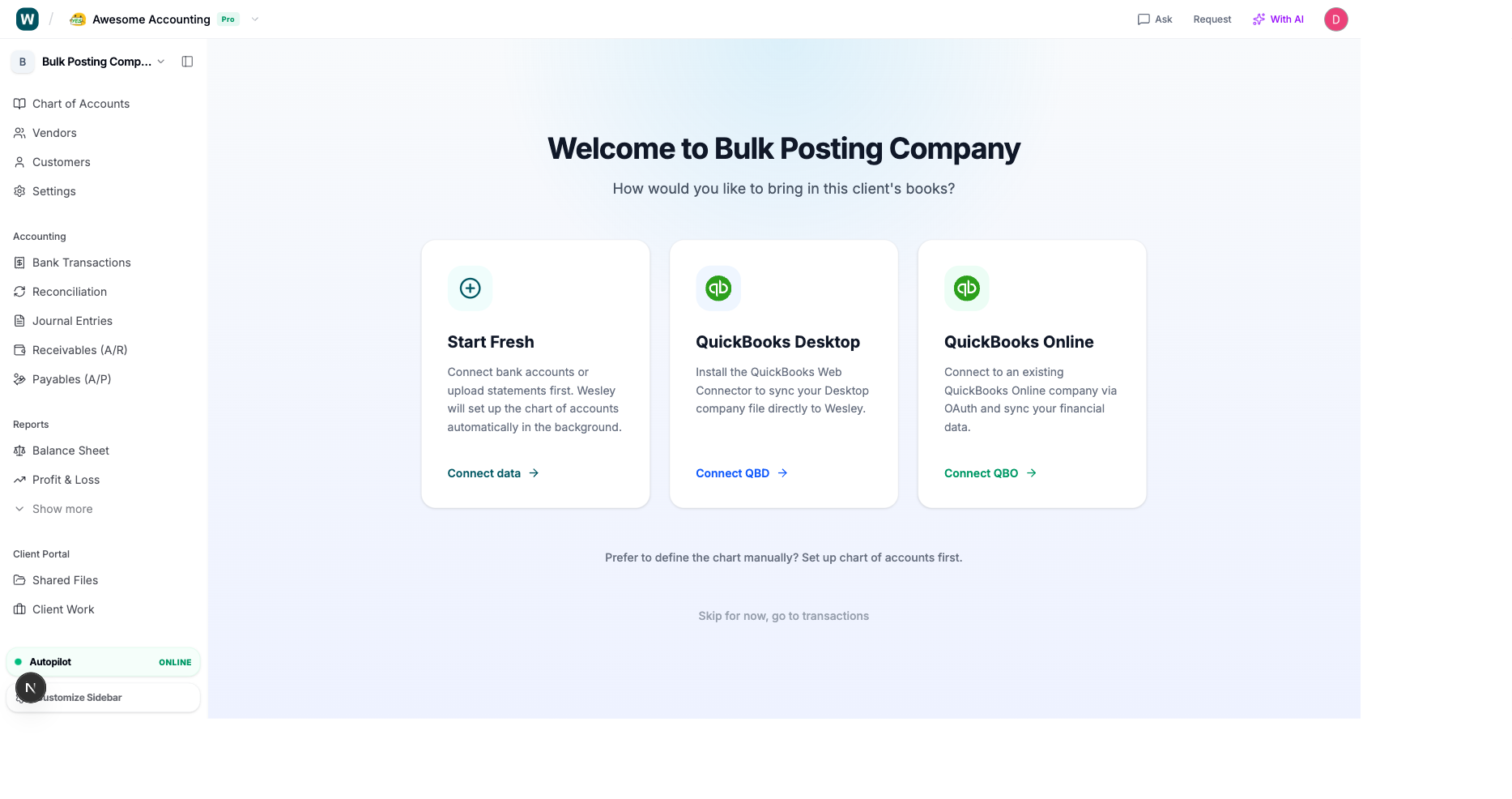 Instead of waiting for a perfect import, the firm can start from the actual bank statements and move immediately into structured cleanup.
The core advantage is not magical autopilot. It is workflow compression:
- Wesley sets or refines a tax-friendly chart of accounts,
- categorizes a large share of transactions consistently,
- groups duplicates and rule-ready items,
- leaves real ambiguity visible for review,
- moves the file toward reports much faster.
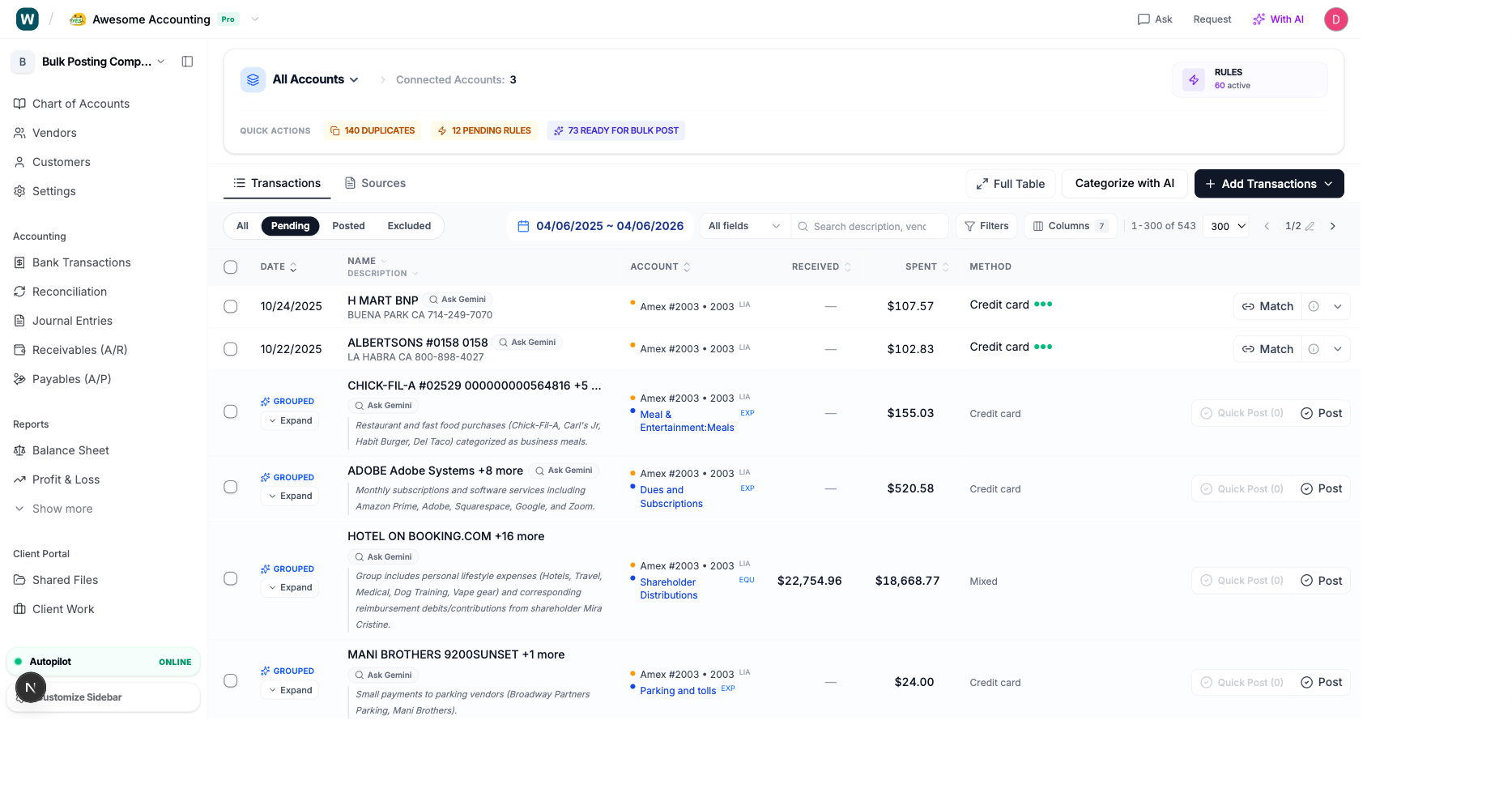 That is the part many firms miss: the money is lost in repetitive first-pass work, not only in final review.
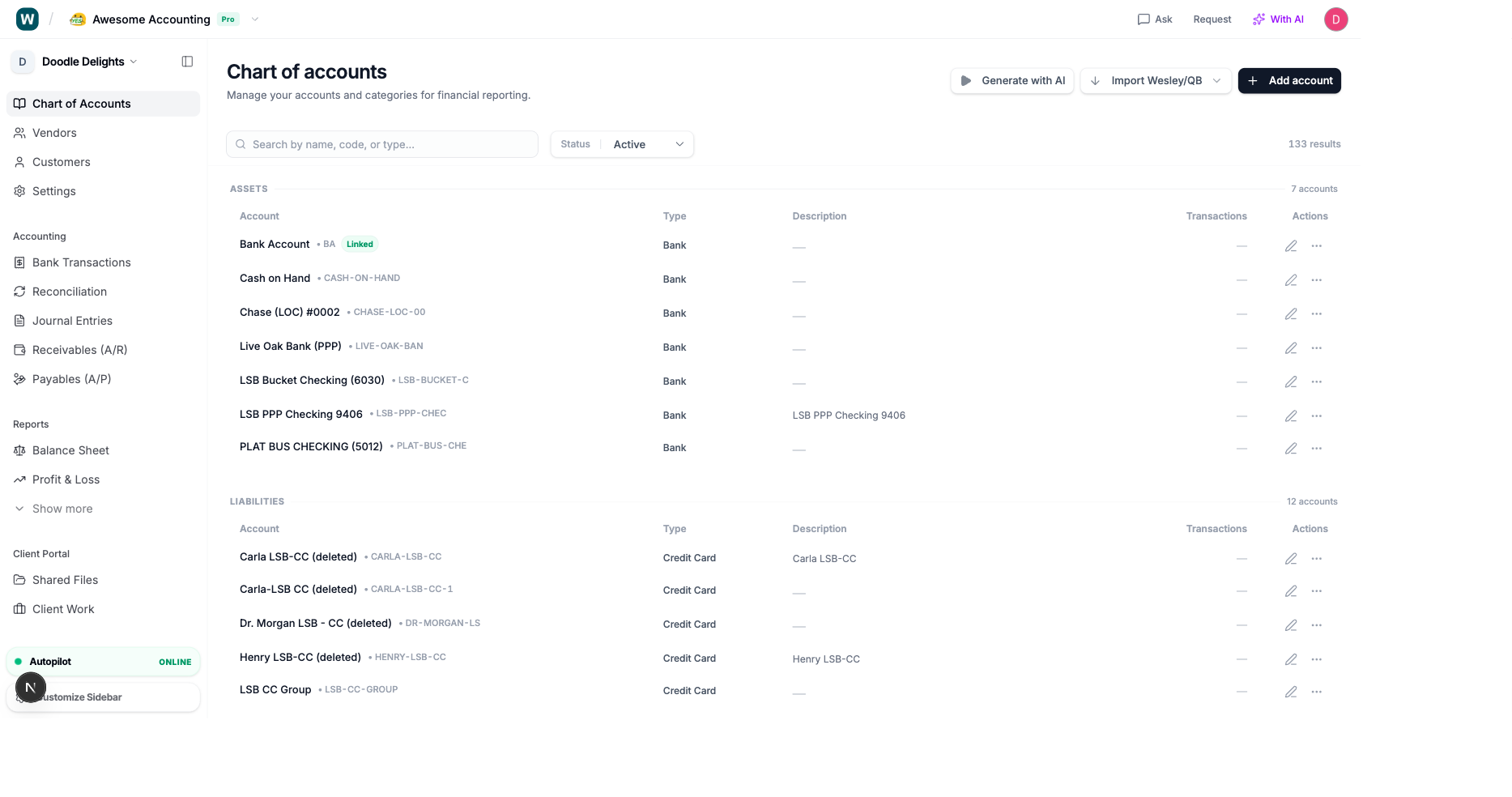 Stable account structure reduces downstream review churn and makes year-end reporting easier to trust.
Once that first pass is done, the reviewer can spend more time on higher-value tax decisions and less time reconstructing the ledger from raw statements.
Where firms lose money without a cleanup system
Accounting firms usually give away margin in four places:
- underpricing messy clients because they scoped by revenue only,
- letting reviewers do bookkeeper-level cleanup,
- chasing clients ad hoc for missing context,
- waiting too long to see whether the P&L and balance sheet are even usable.
Wesley helps because it makes those problems visible sooner.
A better way to talk about tax prep cost with clients
If you want cleaner pricing conversations, frame the engagement in two layers:
1. Return preparation
The filing work itself, including entity-specific tax forms and review.
2. Tax-readiness work
The bookkeeping cleanup needed to make the ledger reliable enough for that filing.
That framing protects margin and helps clients understand why a “simple return” is not always simple.
FAQ
Why does tax prep cost more when the client is behind on bookkeeping?
Because the firm has to reconstruct the ledger before it can prepare the return. That is a separate workload, even if the client thinks it is bundled into tax prep.
How much does catch-up bookkeeping usually add?
It varies widely, but current market references like QuickBooks Live and Monaco CPA both reinforce that cleanup is a meaningful standalone project, not a trivial add-on.
Does better bookkeeping lower tax prep cost?
Almost always. Clean books mean fewer review loops, fewer client questions, and less time spent fixing the same file twice.
What kind of system helps the most during tax season?
A firm-first workflow system that starts from source data, standardizes categorization, surfaces exceptions, and gets the P&L and balance sheet reviewable earlier. That is the role Wesley is built to play.
Try Wesley next
See whether this workflow fits your books
Book a demo, review the workflow with Wesley, and evaluate the fit before asking your team to change how they work.
Related reads
Discover adjacent articles without being sent to near-duplicate topics.


