Tax Prep Costs by Industry in 2026: Why Restaurants, Ecommerce, and Job-Cost Businesses Pay More

A $2 million consulting firm and a $2 million restaurant almost never create the same tax-season workload.
That is the core reason tax prep costs by industry vary so much. The filing deadline may be the same, but the bookkeeping burden underneath it is not.
If your firm works across multiple industries, Wesley is useful because it helps you segment the workload earlier: by business type, open tax status, pending transactions, and the kind of cleanup each client is likely to require.
Quick answer: some industries cost more because the books are harder to trust
Below are directional 2026 ranges for the work required to get a business tax-ready. These ranges are broader than a pure filing fee because in real life the return and the bookkeeping cleanup are usually bundled together in the engagement.
| Industry | Why tax-season work gets harder | If books are mostly clean | If books need cleanup |
|---|---|---|---|
| Solo professional services | low account count, simple revenue, fewer reconciliations | $1,000-$2,500 | $2,500-$5,000 |
| Restaurants and cafes | POS data, tips, payroll, inventory, vendor volume | $2,000-$5,000 | $4,500-$9,000 |
| Ecommerce and omnichannel retail | payouts, sales tax nexus, returns, inventory, COGS | $2,500-$6,000 | $5,000-$12,000 |
| Construction, trades, and project businesses | job costing, subcontractors, progress billing, WIP | $2,500-$6,500 | $5,500-$12,000 |
| Multi-location health, beauty, and wellness | payroll, merchant accounts, location reporting, reimbursements | $2,000-$5,500 | $4,500-$10,000 |
These fee bands are not about one industry being “better” than another. They are about the amount of accounting judgment and reconstruction needed before a preparer can file confidently.
Coverage and resources
Open the authority pages that support this workflow.
Client Document Request Template for Bookkeeping Firms
A reusable client document request template for bookkeepers and accounting firms who need statements, receipts, and exception support without a vague back-and-forth.
Open page →
Uncategorized Transaction Follow-Up Template
A clean follow-up template for asking clients about uncategorized transactions, owner activity, unusual transfers, and missing memo detail without wasting reviewer time.
Open page →
Template library
Browse copyable SOPs, client messages, and bookkeeping checklists.
Open page →
Why restaurants often cost more than owners expect
QuickBooks' own restaurant bookkeeping guide highlights the operational realities that make restaurants hard:
- daily sales reporting,
- POS integrations,
- tips and payroll,
- frequent vendor purchases,
- perishable inventory,
- spoilage and waste.
Restaurants also tend to have:
- high transaction counts,
- multiple merchant deposits,
- owner-paid emergency purchases,
- timing issues between bank activity and POS closeouts.
The result is simple: the preparer is not just filing a return. They are often rebuilding the operating story of the business first.
Why ecommerce books create expensive cleanup
Ecommerce businesses create tax-season pain in a different way:
- marketplace deposits bundle fees, refunds, and net sales,
- inventory and COGS timing matters,
- returns distort simple revenue views,
- multiple payment processors create reconciliation noise,
- sales tax obligations can stretch across states.
Avalara's guide to sales tax nexus is a good reminder that multi-state sales tax obligations expand quickly once a seller has the right connections into multiple states. That means ecommerce books usually need cleaner mapping between:
- gross sales,
- fees,
- shipping,
- refunds,
- tax collected,
- inventory movement.
That is why ecommerce clients often look fine at the bank level but still take much longer to make tax-ready.
Why job-cost businesses are expensive even without huge revenue
Project-driven businesses such as contractors, specialty trades, event production, and some creative or manufacturing shops often require more accounting labor because profitability is not just “income minus expenses.”
QuickBooks' job order costing guide lays out the problem clearly: unique jobs require tracking materials, labor, and overhead at the job level. Once that discipline slips, tax season becomes expensive because the firm is trying to reconstruct:
- job profitability,
- direct versus indirect costs,
- subcontractor expense treatment,
- timing of revenue,
- unfinished or partially billed work.
These businesses are frequently underpriced if the accounting firm scopes the engagement only by annual revenue.
The real industry pricing mistake: using one generic bookkeeping workflow for every client
Most adjacent products are priced generically:
- QuickBooks Live prices ongoing service by spend bands,
- Bench packages bookkeeping and tax in fixed subscription tiers,
- Botkeeper sells firm software by license count.
Those packages are useful benchmarks, but they do not solve the operational question an accounting firm cares about:
Which clients are going to blow up my review queue before the deadline, and how do I separate the easy ones from the expensive ones faster?
That is where Wesley is meaningfully different.
How Wesley helps firms price and process industry complexity earlier
Wesley gives firms a portfolio view that is much more useful than a flat client list.
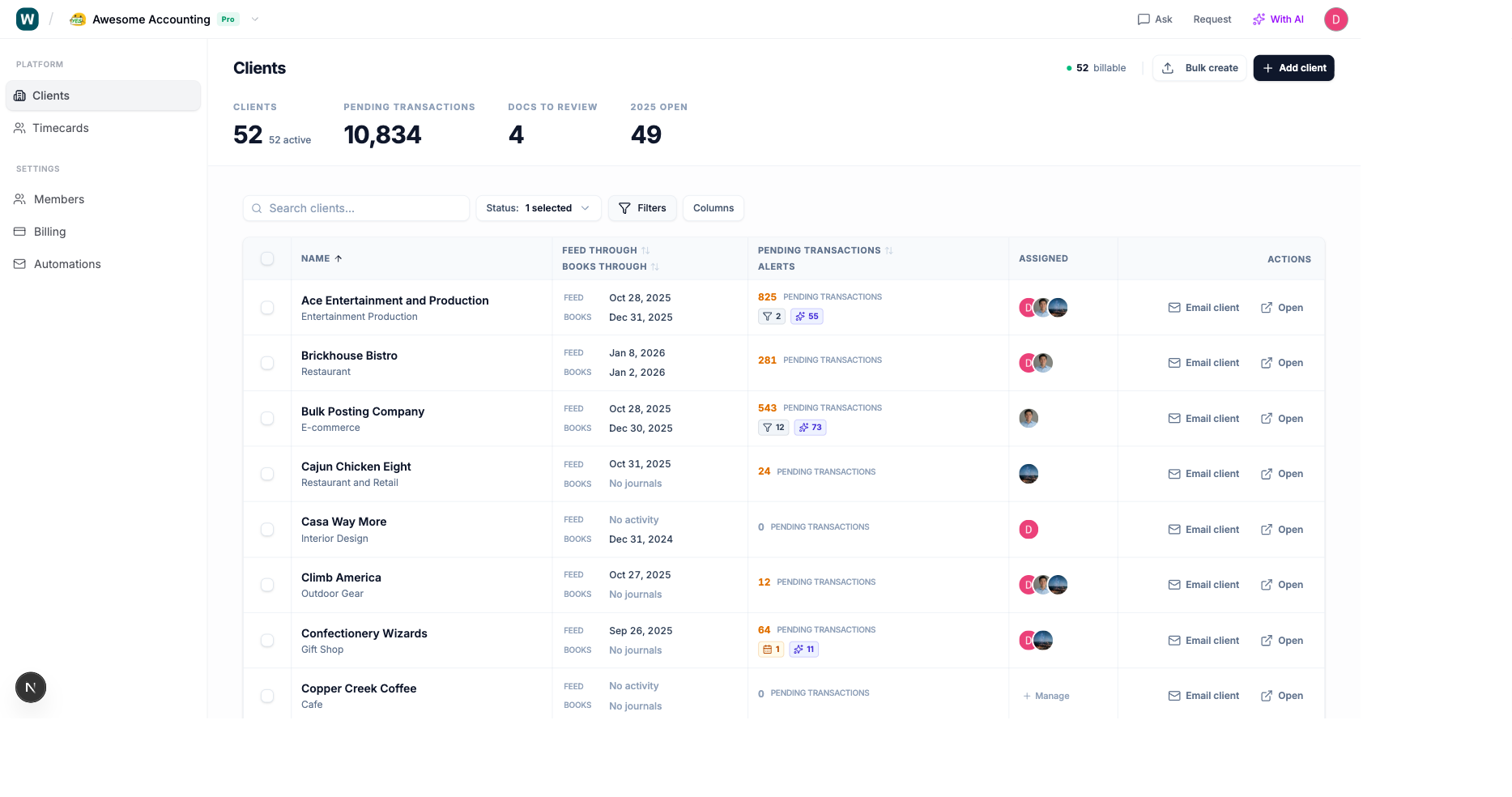 At the firm level, you can see which clients are open, how much transaction backlog exists, and which industries are likely to require heavier cleanup.
On top of that, the filtering layer makes it easier to segment work by tax status and workflow risk.
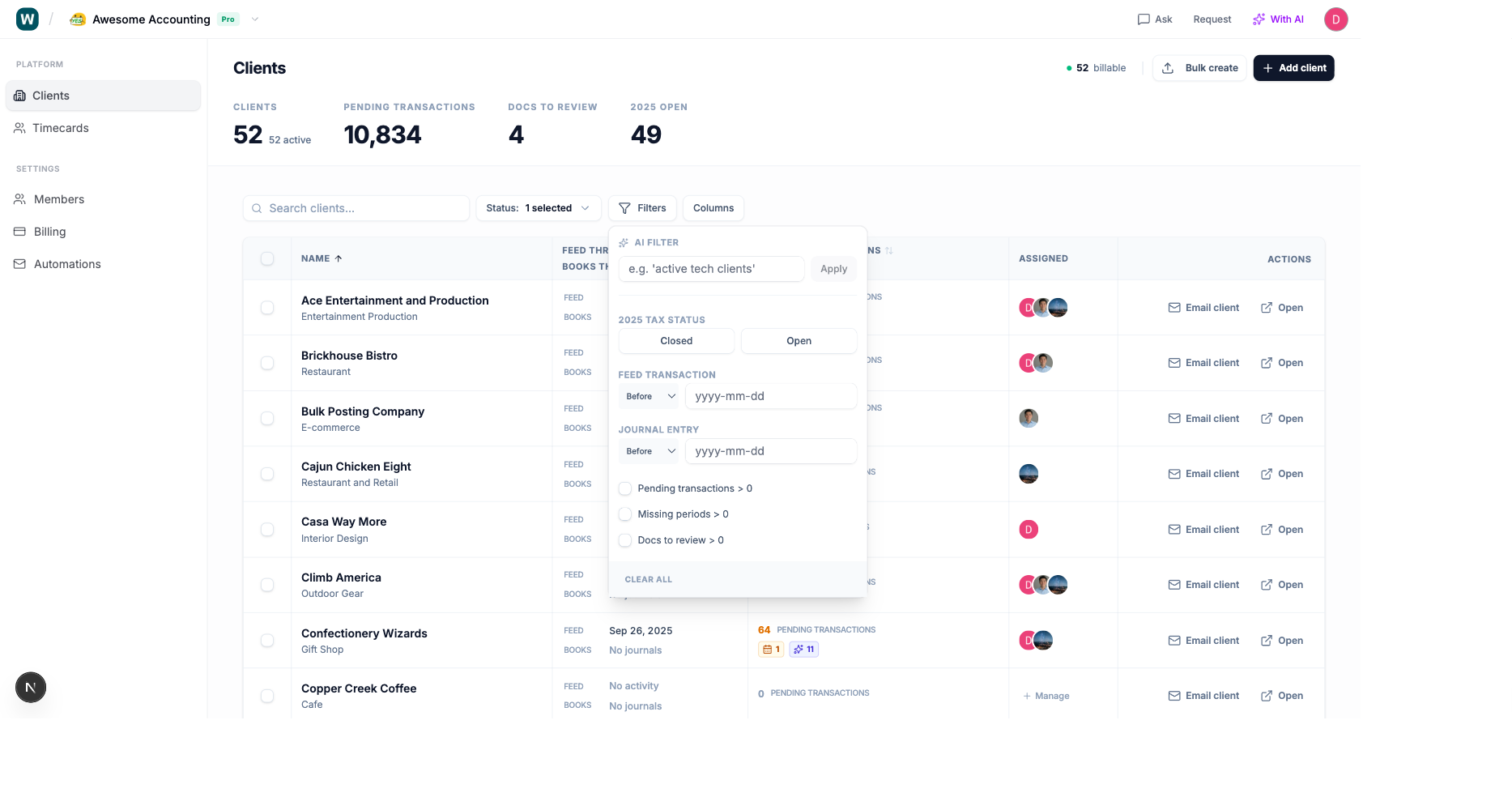 That matters because the firm's real capacity problem is usually prioritization, not awareness.
Once the firm moves into a client file, Wesley uses the actual bookkeeping surface to reduce industry-specific cleanup labor.
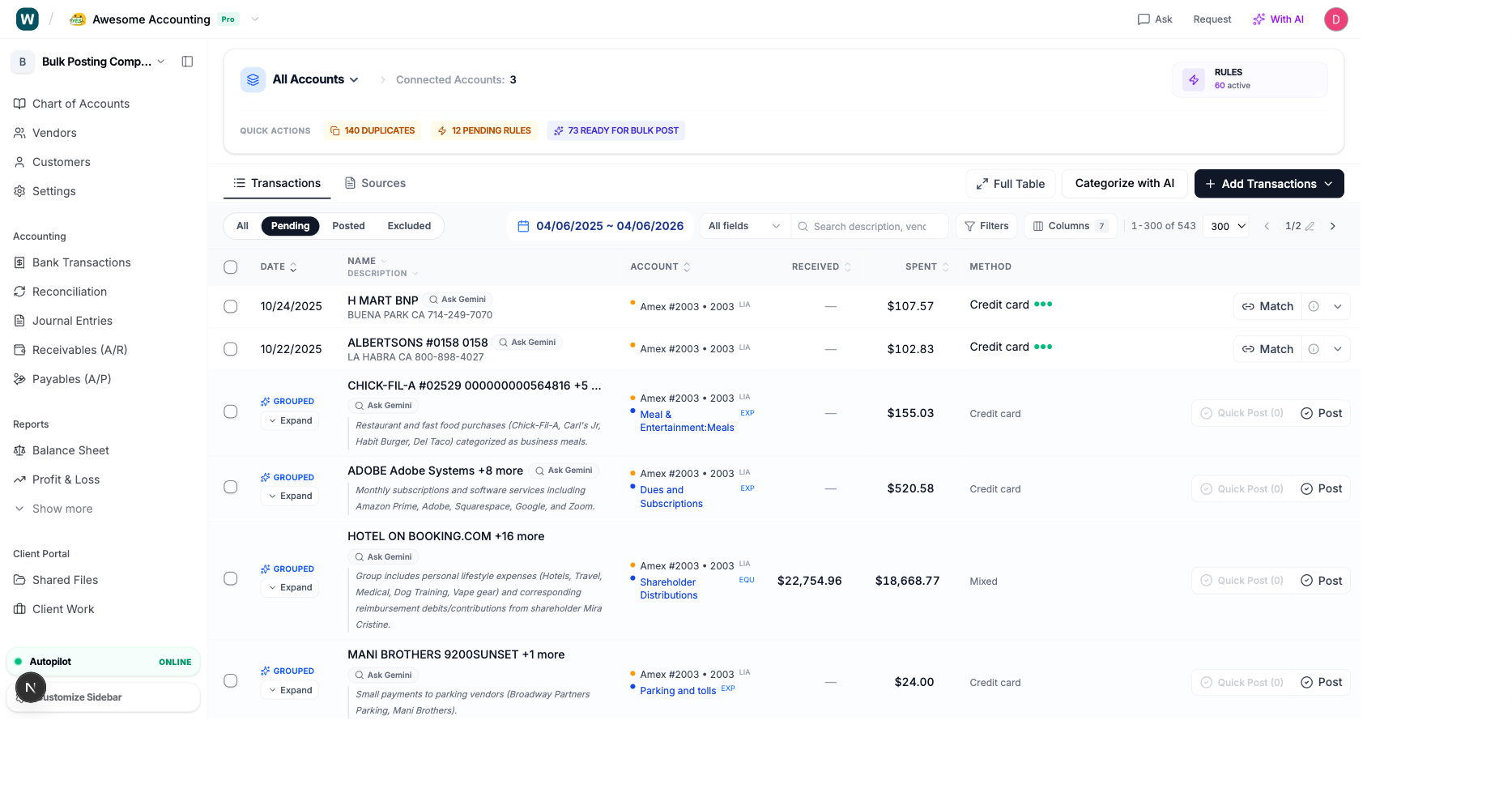 High-volume industries become manageable when the system handles the repetitive work first and leaves only the real exceptions for review.
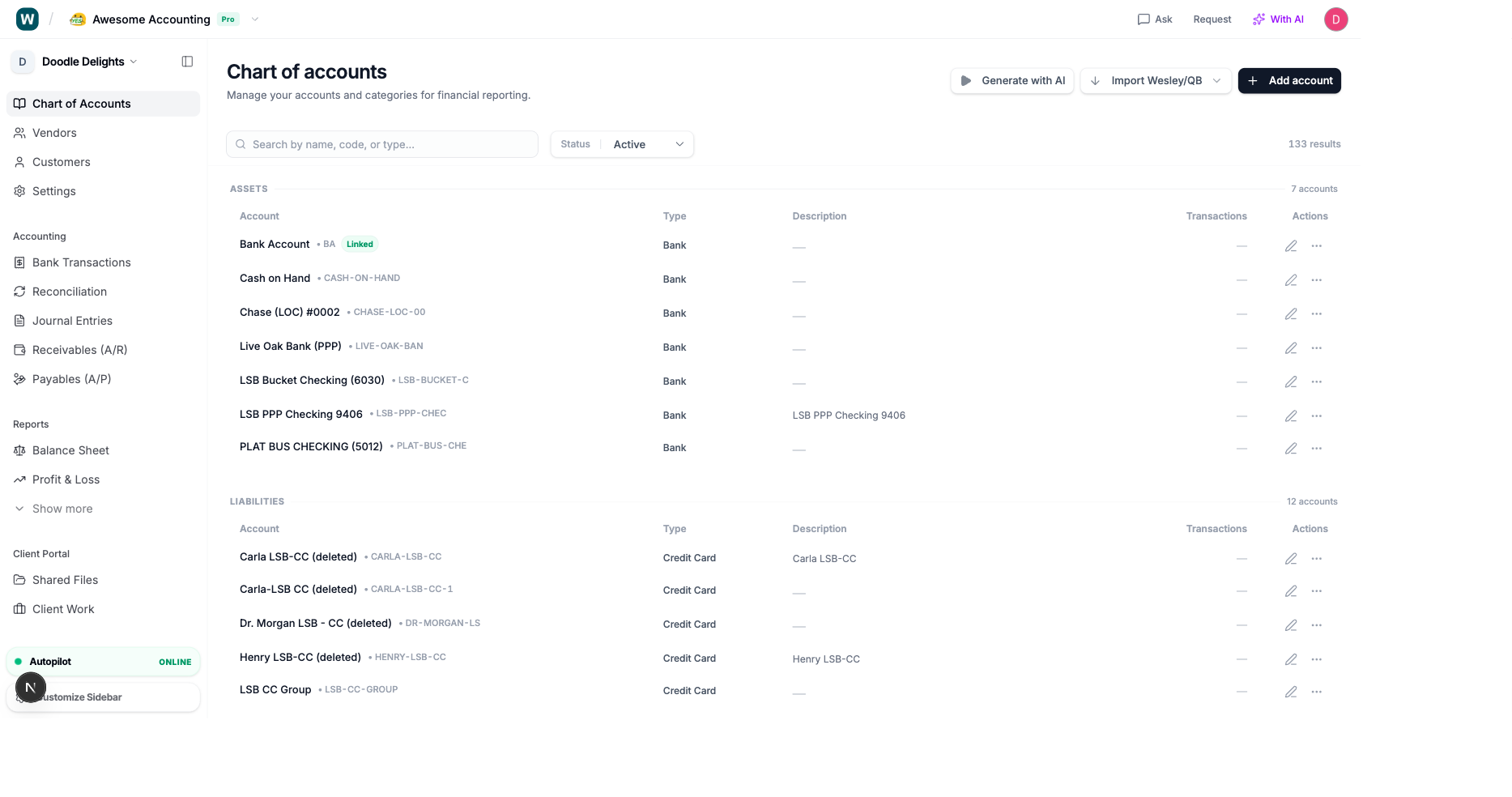 Industry complexity becomes easier to price when the chart of accounts and categorization are consistent across similar clients.
That combination makes Wesley useful not just for bookkeeping execution, but also for positioning and scoping:
- which industries should be priced higher,
- which clients need cleanup projects before tax prep,
- which work can be standardized across a vertical,
- where automation will actually protect margin.
Industry-by-industry positioning takeaways
Professional services
Professional services businesses are often the easiest to standardize. They are a good baseline for lower fees, faster close, and lighter review.
Restaurants
Restaurants need earlier operational cleanup because the transaction pattern is noisy and time-sensitive.
Ecommerce
Ecommerce businesses need better mapping between platform settlements, fees, refunds, and taxes. They are often underquoted if scoped like normal service businesses.
Job-cost businesses
If the firm does not separate project businesses from ordinary service businesses, tax-season margins usually suffer.
FAQ
Why do restaurant tax prep fees run higher?
Because restaurants usually bring a combination of POS data, payroll, tips, vendor volume, and inventory-related accounting issues.
Why are ecommerce books expensive to clean up?
Because marketplace deposits are netted, inventory matters, refunds distort revenue, and sales-tax obligations can span multiple jurisdictions.
Is revenue enough to price tax-season work?
No. Revenue is a weak proxy. Industry structure, transaction volume, and cleanup complexity are far more predictive.
How can a firm handle industry complexity without adding more staff?
Use a workflow that segments the portfolio early and standardizes the bookkeeping first pass. That is exactly the use case Wesley is built for.
Try Wesley next
See whether this workflow fits your books
Book a demo, review the workflow with Wesley, and evaluate the fit before asking your team to change how they work.
Related reads
Discover adjacent articles without being sent to near-duplicate topics.


