How Much Does Small Business Tax Preparation Cost in 2026? By Entity Type, Complexity, and Book Quality

If you are searching for small business tax preparation cost in 2026, the number you get quoted is usually a blend of two jobs:
- preparing the return itself, and
- cleaning the books enough to trust the numbers.
That is why one sole proprietor gets quoted a few hundred dollars while another gets quoted several thousand. The legal entity matters, but book quality and business complexity matter just as much.
If your firm wants to compress the bookkeeping side before tax work starts, Wesley is designed for exactly that first-pass cleanup workflow.
Quick answer: typical 2026 ranges by entity type
These ranges are directional US market ranges, not a statutory fee schedule. They reflect current 2026 pricing signals from products like QuickBooks Live Cleanup, QuickBooks Live Full-Service Bookkeeping, Bench pricing, firm-side cleanup projects, and the real work created by each IRS filing type.
| Business type | Typical federal return | Mostly clean books | Books need cleanup or catch-up | Why fees jump |
|---|---|---|---|---|
| Sole proprietor / single-member LLC | Schedule C | $500-$1,500 | $1,500-$3,500+ | mixed personal/business spend, missing receipts, uncategorized transactions |
| S corporation | Form 1120-S | $1,500-$4,000 | $3,500-$7,500+ | payroll, owner compensation, distributions, shareholder basis, state filings |
| Partnership / multi-member LLC | Form 1065 | $2,000-$6,000 | $5,000-$10,000+ | K-1s, partner capital, partner changes, liabilities, allocations |
| C corporation | Form 1120 | $2,500-$7,500 | $6,000-$12,000+ | balance sheet support, fixed assets, state nexus, corporate schedules |
The mistake many owners make is assuming the entity type alone sets the fee. In reality, the same entity can be cheap or expensive depending on how much pre-tax bookkeeping labor is still sitting in the file.
Coverage and resources
Open the authority pages that support this workflow.
Client Document Request Template for Bookkeeping Firms
A reusable client document request template for bookkeepers and accounting firms who need statements, receipts, and exception support without a vague back-and-forth.
Open page →
Uncategorized Transaction Follow-Up Template
A clean follow-up template for asking clients about uncategorized transactions, owner activity, unusual transfers, and missing memo detail without wasting reviewer time.
Open page →
Template library
Browse copyable SOPs, client messages, and bookkeeping checklists.
Open page →
What adjacent products tell you about the market
Current 2026 market packaging is useful context:
- QuickBooks Live Cleanup markets a one-time cleanup starting at $150/month as a one-time fee, with pricing varying by the number of months needed.
- QuickBooks Live Full-Service Bookkeeping starts at $300/month after an initial cleanup fee.
- QuickBooks' own pricing details also note a $500 cleanup fee at the start of service for Live Full-Service Bookkeeping and then spend-based monthly tiers.
- Bench currently advertises bookkeeping plans starting at $189/month billed annually or $199/month billed monthly, and bookkeeping plus tax starting at $599/month billed annually or $699/month billed monthly.
- Botkeeper prices for accounting firms start from a software-license model rather than a one-off tax cleanup model.
Those products are helpful benchmarks, but they still leave a gap for accounting firms: what does it take to make a messy client tax-ready quickly, especially when the client is arriving with a year of statements instead of clean books?
That is where Wesley is positioned differently. It is built around the accounting-firm workflow between raw bank activity and tax-ready financials.
Why entity type changes the fee
Schedule C businesses are usually the simplest, not always the cheapest
Schedule C is still the lightest common filing path because it does not require a separate pass-through entity return. But Schedule C businesses often become expensive when:
- the owner used one account for business and personal spending,
- there are missing mileage, travel, and home-office support details,
- the firm has to reconstruct a full year from statements,
- deposits and transfers were never explained.
S corporations add payroll, distributions, and shareholder tracking
Form 1120-S adds a separate entity return, shareholder reporting, and K-1 output. In practice, the quote rises when the bookkeeper has to untangle:
- officer compensation,
- shareholder distributions,
- payroll tax timing,
- reimbursable expenses,
- multi-state payroll or apportionment issues.
Partnerships usually get expensive faster than owners expect
Form 1065 is where complexity can jump fast because the return often depends on:
- partner capital movements,
- basis-sensitive items,
- guaranteed payments,
- liability allocations,
- partner additions or exits,
- separate state requirements.
That is why a partnership with only moderate revenue can still be more expensive than a larger Schedule C client.
C corporations shift attention to balance sheet quality
C corporation work gets more expensive when the balance sheet cannot be trusted. If retained earnings, shareholder loans, fixed assets, payroll liabilities, and tax accruals are off, the preparer is no longer just filing a return. They are effectively doing forensic cleanup first.
The real fee driver is book quality
Two S corps with the same revenue can get wildly different quotes. The lower-fee file usually has:
- reconciled bank and credit-card accounts,
- a stable chart of accounts,
- few uncategorized transactions,
- clean owner-draw and reimbursement treatment,
- current P&L and balance sheet reports.
The higher-fee file usually has:
- twelve months of uncategorized activity,
- duplicate or vague accounts,
- unresolved transfers,
- missing support,
- year-end bank statements dropped in all at once.
That difference is exactly where Wesley can change the economics for an accounting firm.
How Wesley reduces tax-season bookkeeping labor before the return starts
Wesley is built for the moment when a client shows up late, the books are incomplete, and the firm still needs a tax-ready first pass fast.
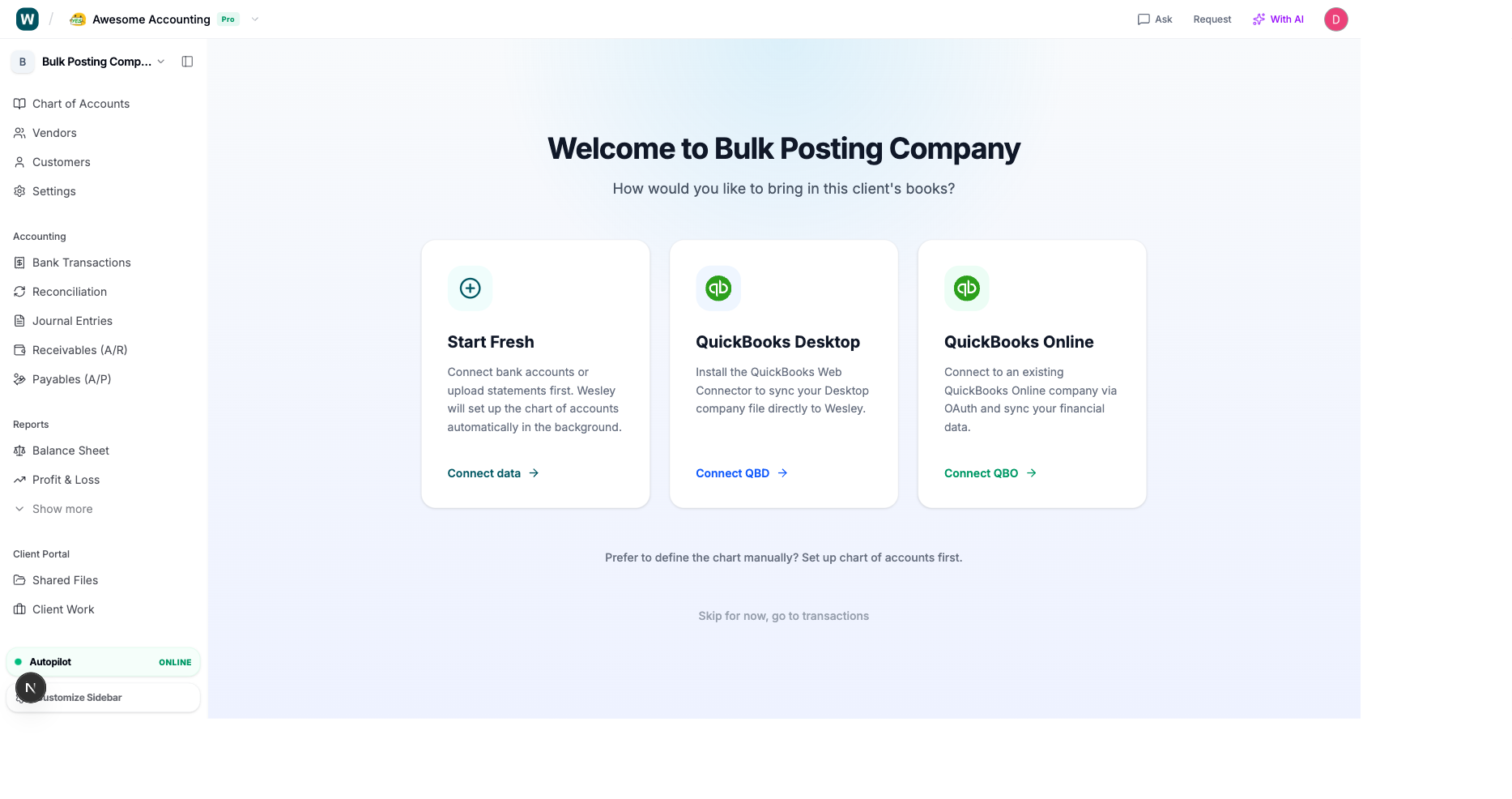 Wesley lets the firm start from bank statements or prior accounting data instead of waiting for a perfect historical file.
Inside Wesley, the workflow is:
- upload or connect the raw source data,
- let the platform build or refine the chart of accounts around the business,
- categorize the bulk of transactions consistently,
- isolate the ambiguous exceptions,
- move into review with a usable P&L and balance sheet instead of a blank file.
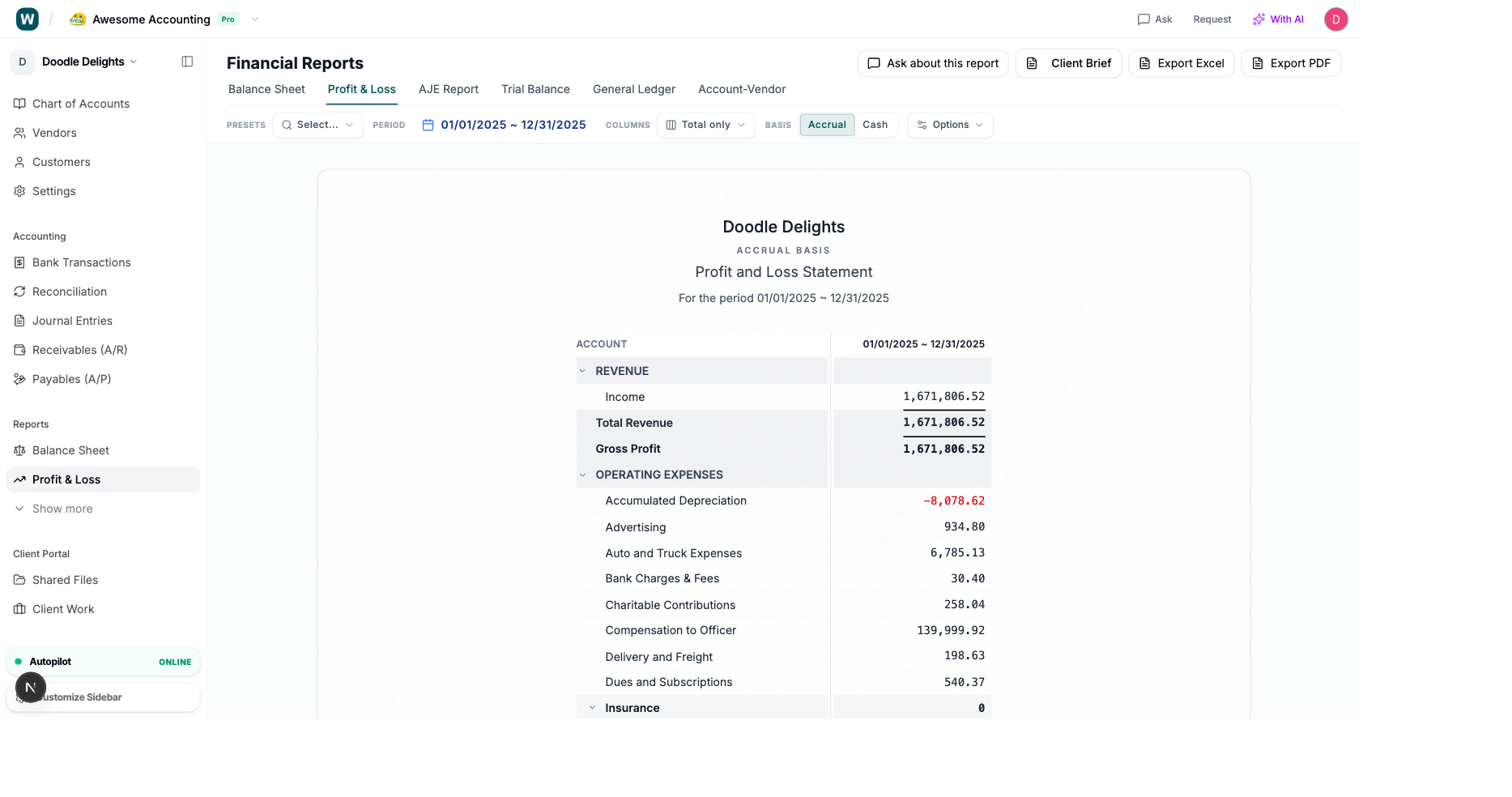 The goal is to get to a reviewable P&L quickly, so the reviewer is deciding tax treatment instead of doing raw cleanup from scratch.
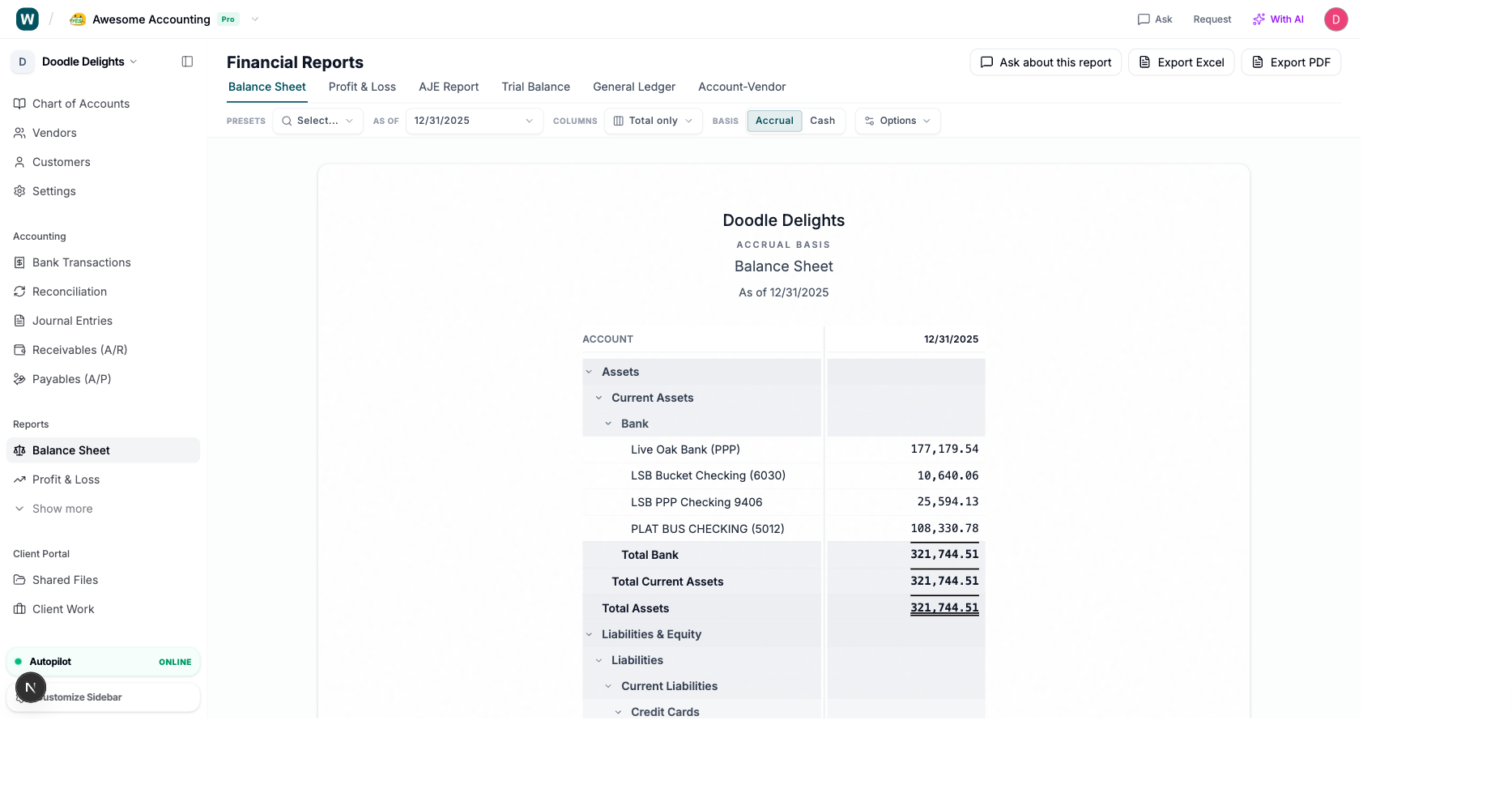 For entity returns, the balance sheet is often where the true risk sits. Wesley surfaces it earlier in the process.
This matters because the biggest source of tax-season write-offs is not the tax software. It is bookkeeping labor that was never scoped correctly up front.
Positioning takeaway for accounting firms
If you compare the adjacent market, you can see three buckets:
- SMB-facing monthly bookkeeping subscriptions,
- outsourced bookkeeping platforms,
- tax software that assumes the books are already good enough.
Wesley sits in a more operationally useful position for firms that inherit messy books near deadlines: bank-statement-first, tax-ready bookkeeping acceleration for accounting firms.
That positioning is especially strong when the client arrives with:
- 12 months of statements,
- no reliable chart of accounts,
- open questions around owner activity,
- and a looming filing deadline.
FAQ
Is Schedule C always cheaper than an S corp return?
Usually yes, but not if the Schedule C books are badly mixed with personal spending or need a full cleanup from statements.
Why does Form 1065 usually cost more?
Because partnerships usually bring partner capital, K-1s, allocations, liability treatment, and more review-sensitive equity questions.
Can cleaner books reduce tax prep fees?
Yes. Firms charge less when they can trust the ledger faster. Cleaner books mean less reconstruction, less client chasing, and fewer review loops.
What is the practical way to lower small business tax prep cost?
Get the books tax-ready earlier. For firms, that means using a workflow like Wesley to convert raw bank activity into a reliable first-pass ledger before deep tax review begins.
If you want a faster path from bank statements to year-end reports, Wesley is built for that accounting-firm workflow.
Try Wesley next
See whether this workflow fits your books
Book a demo, review the workflow with Wesley, and evaluate the fit before asking your team to change how they work.
Related reads
Discover adjacent articles without being sent to near-duplicate topics.


