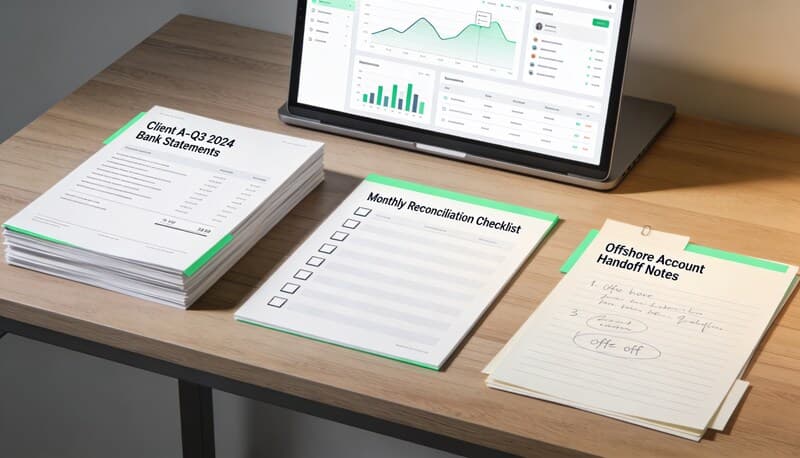
Offshore Bookkeeping QA Checklist for CPA Firms
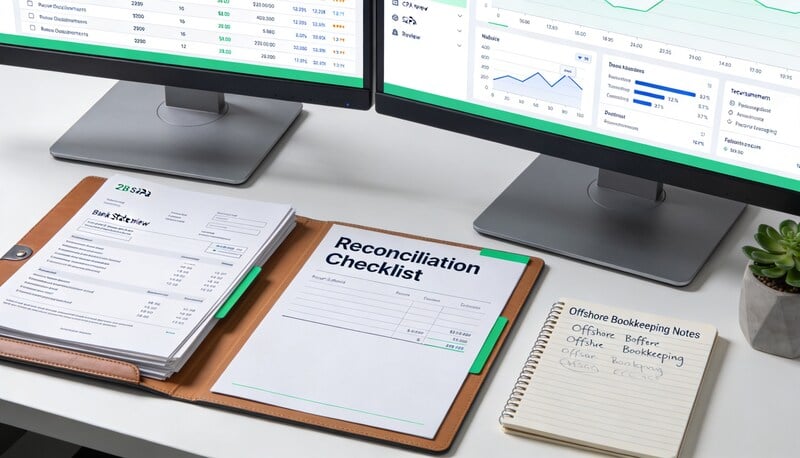
Offshore bookkeeping usually fails in the review layer, not in the staffing contract. The work can be technically complete while still being unusable for a CPA firm because the reviewer cannot see what was checked, what was assumed, and what still needs a client answer.
Quick answer
A good offshore bookkeeping QA checklist should verify source completeness, bank reconciliation status, transaction coding logic, unresolved client questions, period cutoff, supporting documents, and review notes before the file reaches a senior reviewer. The goal is not to inspect every row twice. The goal is to make exceptions obvious.
Coverage and resources
Open the authority pages that support this workflow.
Supported banks
See which institutions Wesley already covers and when statement fallback still matters.
Open page →
Integrations hub
See where Wesley fits before QuickBooks, Xero, QIF, Sage, and NetSuite workflows.
Open page →
Template library
Use saveable SOPs and checklists alongside the workflow pages.
Open page →
Who this is for
This guide is for CPA firms, CAS teams, and bookkeeping managers using offshore or outsourced capacity for monthly bookkeeping. It is especially useful when senior staff are spending too much time cleaning up work that should have arrived review-ready.
The operating problem
Most firms treat QA as a final glance. That creates two bad options: either the reviewer trusts work that may be incomplete, or the reviewer redoes the work from scratch. Offshore teams need a visible definition of quality so the reviewer can evaluate the work product without reconstructing every decision.
The workflow
Use this workflow before a file moves from preparer to reviewer. It works best when each item has an owner, evidence, and a clear pass or exception state.
- Confirm all source files are present: bank statements, credit card statements, payroll reports, loan statements, merchant processor exports, and client-provided context.
- Tie every cash and credit card account to the statement ending balance for the period under review.
- Separate uncategorized transactions from transactions that were categorized with low confidence.
- Attach or reference support for material transactions instead of leaving support buried in email.
- Flag any transaction where the coding decision depends on business context the offshore team does not have.
- Summarize open questions in one place before routing the file back to the client or reviewer.
- Mark the period as ready for review only after reconciliation, coding, and question queues have each been checked.
Checklist
- Every account in scope has a statement or source export.
- Beginning and ending balances agree to source documents.
- Bank feed gaps, duplicate imports, and manually added transactions are flagged.
- Transfers are matched across accounts instead of coded as income or expense.
- Owner draws, loan payments, payroll clearing, and merchant deposits are reviewed separately.
- Transactions needing client context are collected in one queue.
- Material unusual items include a short preparer note.
- The reviewer can see what changed since the prior review cycle.
What to document before handoff
- Client name, entity, period, and accounts covered.
- Source files received and source files still missing.
- Reconciliation status by account.
- Top uncategorized or low-confidence transactions.
- Assumptions the preparer made.
- Questions that must go to the client before close.
- Reviewer decisions requested.
Review signals that matter
- The number of open questions is going down over time.
- Review notes are about judgment calls, not missing source documents.
- The same exception does not appear for the same client every month.
- Senior reviewers can sample work instead of rebuilding the month.
- Client follow-up happens from a single list, not scattered Slack and email threads.
Where Wesley fits
Wesley is useful when the QA problem lives between document intake, bank statement conversion, transaction review, and client follow-up. A firm can use Wesley for accounting firms to keep review notes and transaction questions tied to the work instead of asking reviewers to chase context across files. For statement-heavy work, start with the bank statement to CSV workflow and route exceptions into the review process.
FAQ
Should offshore bookkeeping QA happen before or after reconciliation?
Both. A light QA pass should happen before reconciliation to confirm source completeness. The full QA checklist should happen after reconciliation and before senior review.
How detailed should preparer notes be?
Notes should explain exceptions, not narrate normal work. A reviewer needs to know what is unusual, what was assumed, and what still needs a decision.
Can this checklist replace senior review?
No. It makes senior review faster by removing missing-source and low-context work from the review queue.
Try Wesley next
See whether this workflow fits your books
Book a demo, review the workflow with Wesley, and evaluate the fit before asking your team to change how they work.
Related reads
Discover adjacent articles without being sent to near-duplicate topics.