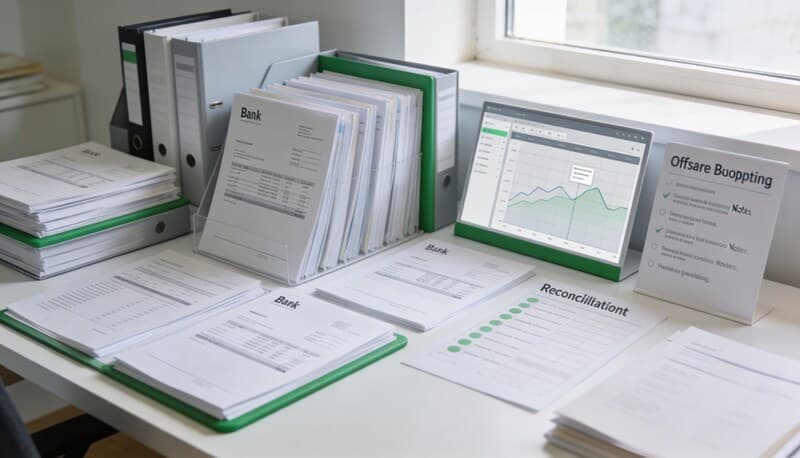
How to Collect Bank Statements From Clients Without Email Chaos

One of the most frustrating accounting-firm bottlenecks is not the bookkeeping itself. It is getting the right files from clients at the right time.
That is why searches like how to collect bank statements from clients, document request software for accountants, and accountant client portal document requests keep growing.
The problem is not just file upload. The problem is workflow:
- where the request lives,
- how the client receives it,
- whether the upload is connected to the right client,
- and whether the bookkeeping team can see what is still missing.
Wesley is useful here because document collection is tied directly to client work, the client portal, and the bookkeeping context.
What the adjacent market solves well
Several adjacent tools are solving parts of this problem:
- TaxDome focuses on secure communication, file uploads, requests, and reminders inside a client portal.
- Dext focuses on automating data capture and reducing the time spent chasing receipts and invoices.
- Uncat Zero focuses on getting client answers about transactions faster than spreadsheets and email.
Those are real pain points. But many firms still end up with the same operational mess:
- request sent in one tool,
- file uploaded in another,
- follow-up done by email,
- bookkeeping status tracked in a spreadsheet or memory.
That is where Wesley has a stronger accounting-firm use case.
Choose your workflow
Bank statement to CSV converter
Start from the general statement-conversion workflow.
PDF to CSV converter
Use the broad PDF-to-CSV workflow for statement and document cleanup.
Bank statement conversion hub
The full cluster for PDF, CSV, OCR, and review-first statement workflows.
Import bank statements into QuickBooks Online
QBO upload path for PDF, image, QBO, QFX, and CSV statement files.
Convert a bank statement PDF to CSV for free
Best for one-off statement cleanup and quick spreadsheet-ready exports.
Coverage and resources
Open the authority pages that support this workflow.
Supported banks
See which institutions have dedicated coverage pages and where statement fallback still makes sense.
Open page →
Supported statement types
See which source documents Wesley can clean up before export or import prep.
Open page →
Bank Statement Cleanup SOP for Bookkeepers
A bank statement cleanup SOP for bookkeepers who need a repeatable review process before exporting to QuickBooks, Xero, QIF, or spreadsheet workflows.
Open page →
The problem is not “file storage.” It is request-to-workflow linkage.
When document collection breaks down, it is usually because the request is disconnected from the bookkeeping work.
The firm needs a system where the same workflow can handle:
- the request,
- the upload destination,
- the client’s response path,
- and the review status afterward.
Wesley’s shared-files workflow is built for that
Instead of forcing the firm to improvise, Wesley gives the team a document workspace tied directly to the client.
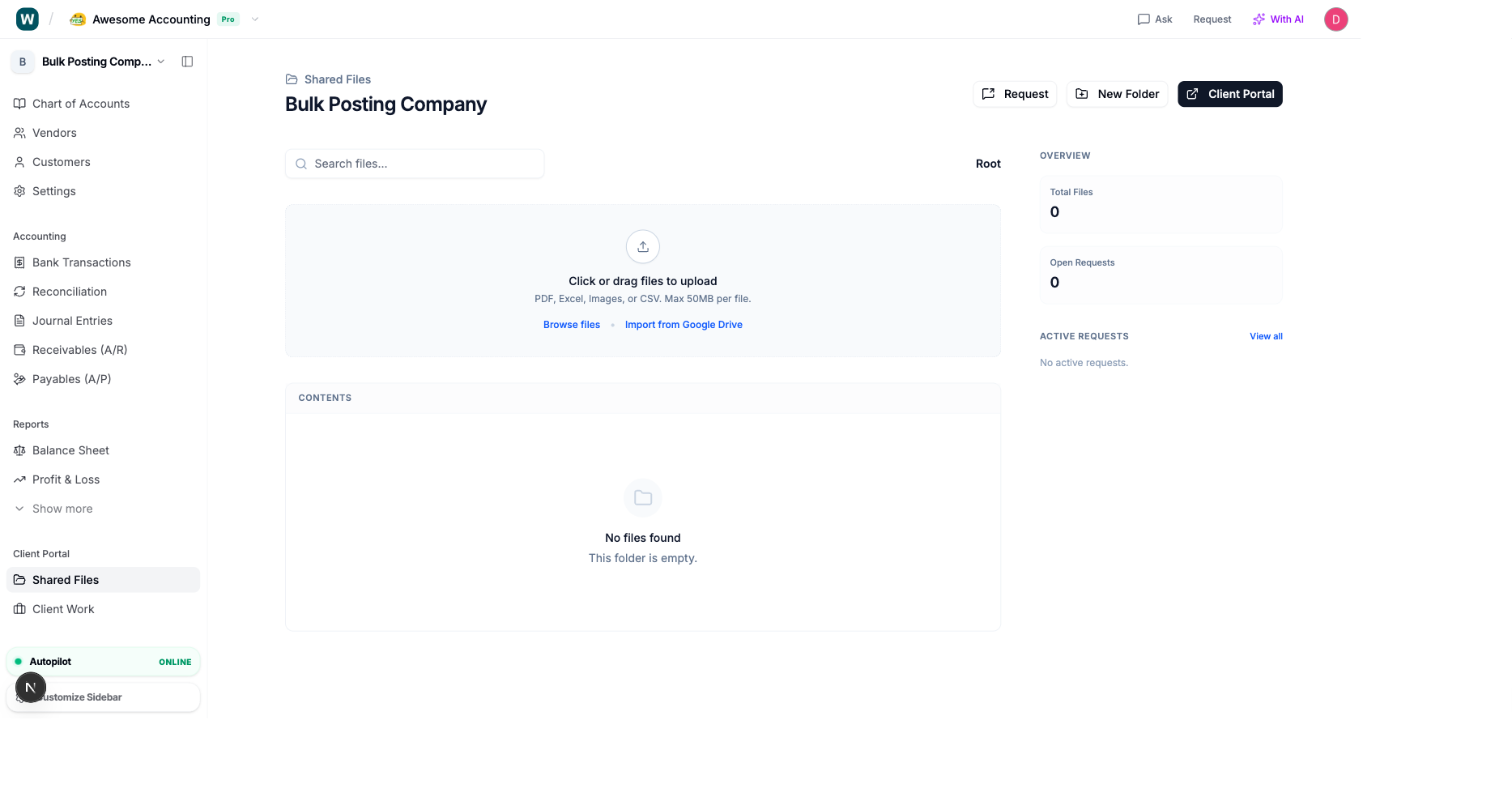 The important detail is not that files can be uploaded. It is that the request and the destination are already tied to the right client context.
That means the firm can:
- request statements or supporting files,
- upload documents internally,
- let clients upload directly,
- and keep the bookkeeping team anchored to the same client record.
The request itself can become structured work, not just another email
This is one of the most useful details in Wesley.
When the firm creates a request, the modal is not just a message box. The request is designed to appear in the Client Portal Work tab and trigger an email notification.
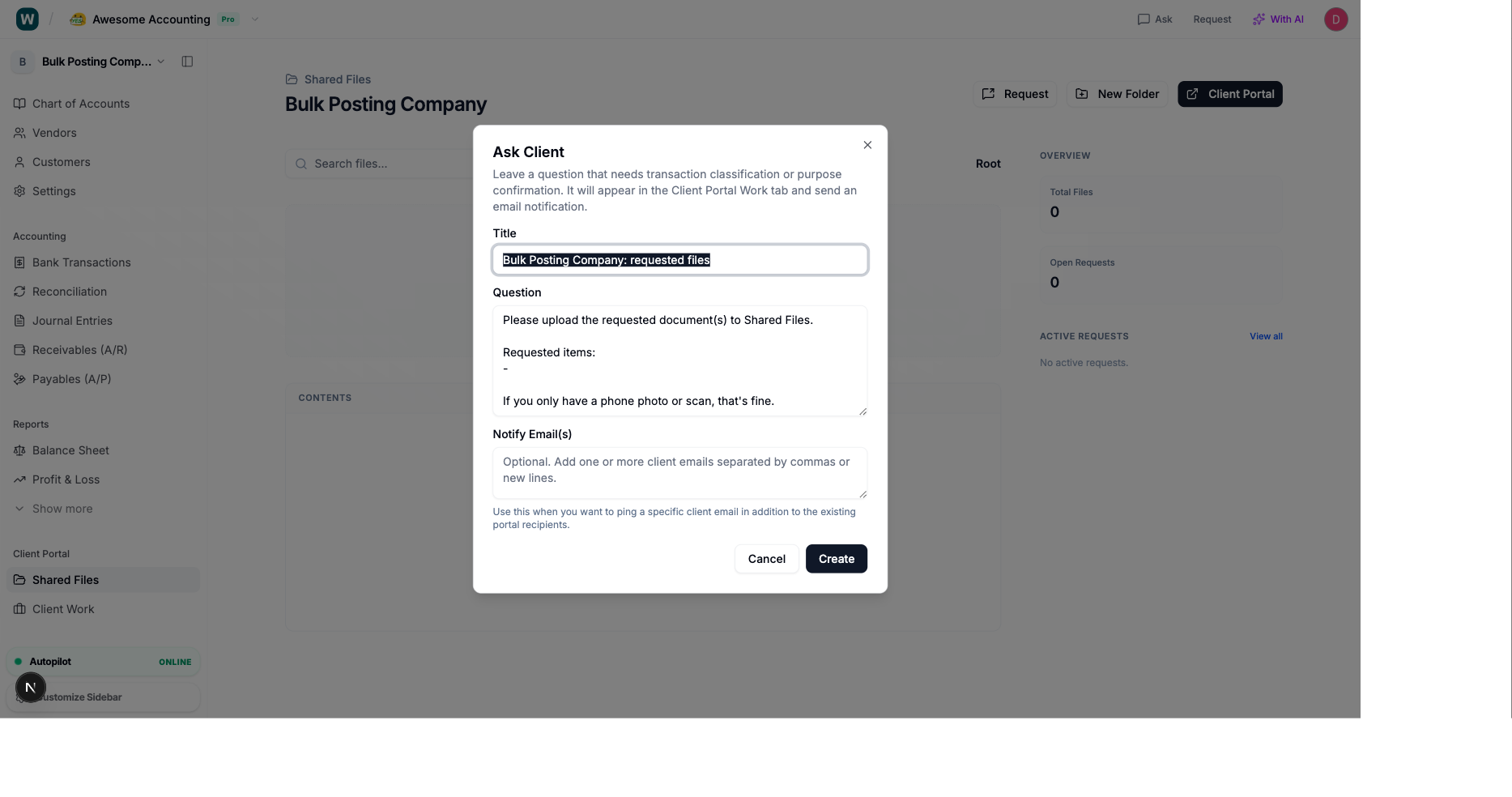 That is a better pattern than free-form email because the bookkeeping request lives in the same system as the document workflow.
In practice, this reduces the classic problems:
- “I sent it, but I can’t find it.”
- “The client replied, but only in email.”
- “The reviewer does not know whether the statement arrived.”
- “We requested the file, but it never got tied back to the client file cleanly.”
Firms still need portfolio-level visibility
Good document collection does not stop at the client page. The firm also needs to see where review pressure is building across the whole book.
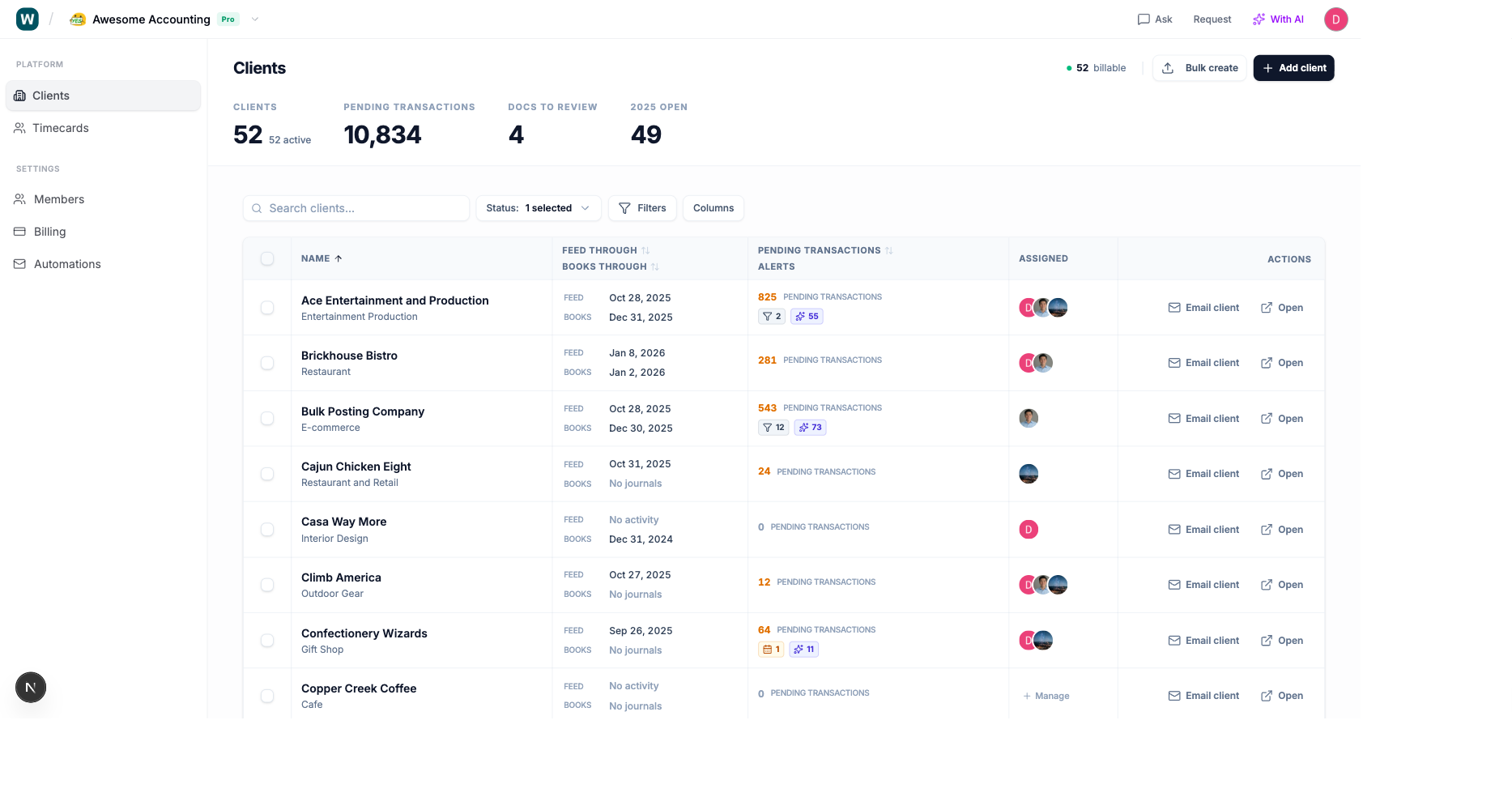 Document collection only becomes truly useful when the firm can see the queue at the portfolio level, not one client at a time.
That is one of the clearest positioning differences between Wesley and more generic portal or file-request tools:
- portal tools help with secure communication,
- capture tools help with file ingestion,
- Wesley connects file requests to the actual bookkeeping operating system of the firm.
Why this matters so much during tax season and catch-up work
When a client is behind, document collection is usually the gating item:
- bank statements are incomplete,
- support for unusual transactions is missing,
- the bookkeeping team cannot finish categorization,
- tax prep stalls because the books are still waiting on evidence.
If the request lives next to the work instead of outside it, the firm moves faster.
That is the value of Wesley here. It is not only a place to upload files. It is a way to turn document chasing into controlled workflow.
FAQ
What is the best way to collect bank statements from clients?
The best workflow is a secure client-facing request tied directly to the client file and visible to the bookkeeping team, not a loose email chain.
Why are email-based document requests so inefficient?
Because requests, replies, uploads, and bookkeeping status all end up in different places. That creates rework and delay.
Is a client portal enough by itself?
Not always. A portal helps, but the firm still needs the request and the upload to connect directly to the bookkeeping workflow.
Why is Wesley strong for this use case?
Because Wesley connects the shared-files workspace, request modal, client portal, and portfolio visibility into one accounting-firm workflow instead of splitting them across separate tools.
Ready to use the matching workflow?
Bank statement to CSV converter
Start from the general statement-conversion workflow.
Related reads
Discover adjacent articles without being sent to near-duplicate topics.