Catch-Up Bookkeeping for Tax Season: Turn 12 Months of Bank Statements Into a Profit and Loss and Balance Sheet in 1 Hour

Catch-Up Bookkeeping for Tax Season Usually Starts With the Same Client Email
A client sends 12 months of bank statements right before the filing deadline and asks for tax-ready books fast. That is the moment firms start searching for answers to questions like catch-up bookkeeping, year-end bookkeeping cleanup, profit and loss statement from bank statements, and balance sheet from bank statements.
That is the workflow Wesley is built for. Wesley is not just a place to upload statements. It is a bookkeeping-optimized engine that turns bank-statement-first cleanup into a structured path to tax-ready books.
Once the statements are uploaded, Wesley can:
- set up a tax-reporting-friendly chart of accounts in the background
- use business and industry context to improve categorization
- classify the majority of transactions consistently and at high confidence
- group repeat activity so reviewers can post quickly instead of working line by line
- isolate only the ambiguous transactions that actually need human judgment
- let the bookkeeper resolve known items directly
- send true missing-information items into a client data-chase workflow with
Ask Client
That is how a full year of statements can turn into a reviewable Profit and Loss and Balance Sheet in about an hour for the right kind of cleanup client.
Choose your workflow
Bank statement to CSV converter
Start from the general statement-conversion workflow.
PDF to CSV converter
Use the broad PDF-to-CSV workflow for statement and document cleanup.
Bank statement conversion hub
The full cluster for PDF, CSV, OCR, and review-first statement workflows.
Import bank statements into QuickBooks Online
QBO upload path for PDF, image, QBO, QFX, and CSV statement files.
Convert a bank statement PDF to CSV for free
Best for one-off statement cleanup and quick spreadsheet-ready exports.
Coverage and resources
Open the authority pages that support this workflow.
Supported banks
See which institutions have dedicated coverage pages and where statement fallback still makes sense.
Open page →
Supported statement types
See which source documents Wesley can clean up before export or import prep.
Open page →
Bank Statement Cleanup SOP for Bookkeepers
A bank statement cleanup SOP for bookkeepers who need a repeatable review process before exporting to QuickBooks, Xero, QIF, or spreadsheet workflows.
Open page →
Client Document Request Template for Bookkeeping Firms
A reusable client document request template for bookkeepers and accounting firms who need statements, receipts, and exception support without a vague back-and-forth.
Open page →
What Is Catch-Up Bookkeeping During Tax Season?
Catch-up bookkeeping during tax season usually means the client did not keep the books current, but the firm still has to produce usable financials fast enough for tax preparation.
That work is slow in a traditional system because the team has to do four things manually:
- build or clean the chart of accounts
- categorize transactions one by one
- chase missing payee or purpose details
- review reports only after the cleanup is mostly done
Wesley's catch-up bookkeeping workflow shortens all four steps by making the upload itself the start of the accounting workflow, not the end of document collection.
Step 1: Start in orgs so the tax-season cleanup is scoped correctly
Before anything else, start in orgs. This is where the firm, client, and reporting period get locked in before anyone starts touching the data.
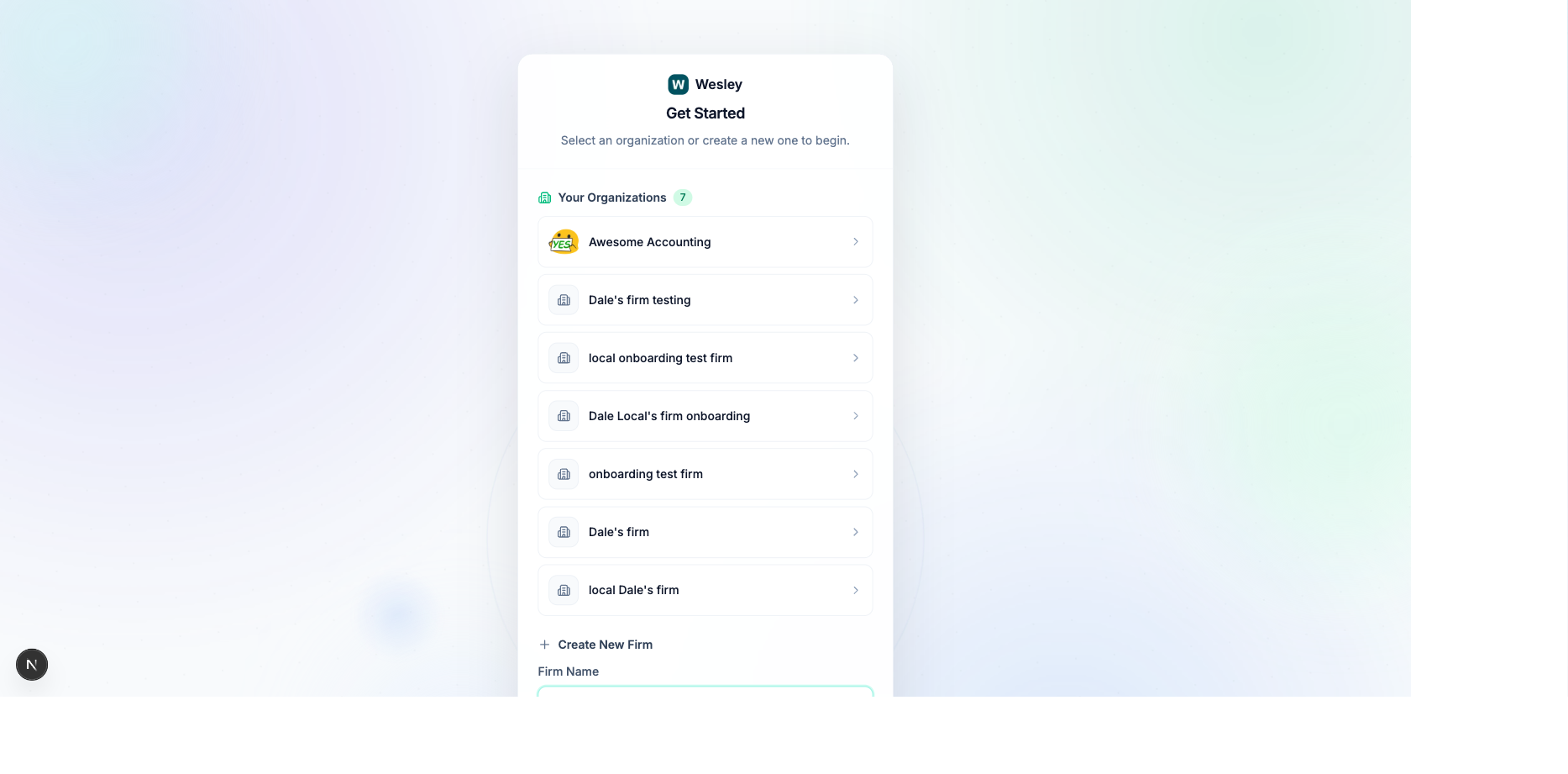
The orgs page is where a clean tax-season bookkeeping workflow begins.
At this point, confirm:
- whether this is annual catch-up bookkeeping or ongoing monthly bookkeeping
- the exact period you are building, usually January 1 through December 31
- whether the goal is tax-ready first-pass books, not a full controller-style close
That small amount of scoping prevents confusion later when the team starts reviewing transactions and reports.
Step 2: Upload 12 months of bank statements and let Wesley start the bookkeeping engine
Once the client is in the right onboarding path, upload the full year of bank statements and credit card statements. In Wesley, this is not just document storage. This is the starting point for bank-statement-first bookkeeping.
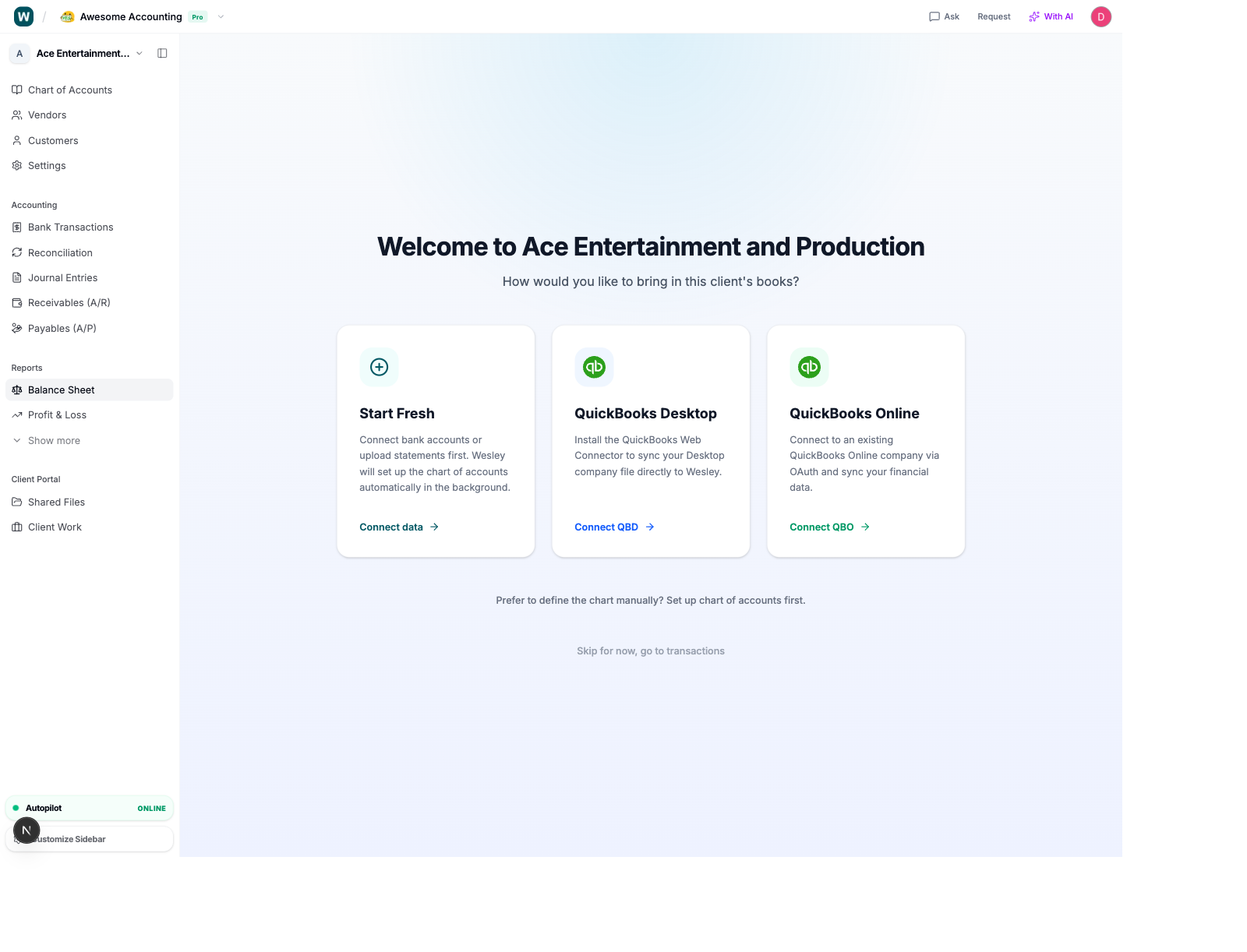
Wesley starts shaping the chart of accounts automatically once bank data is brought in.
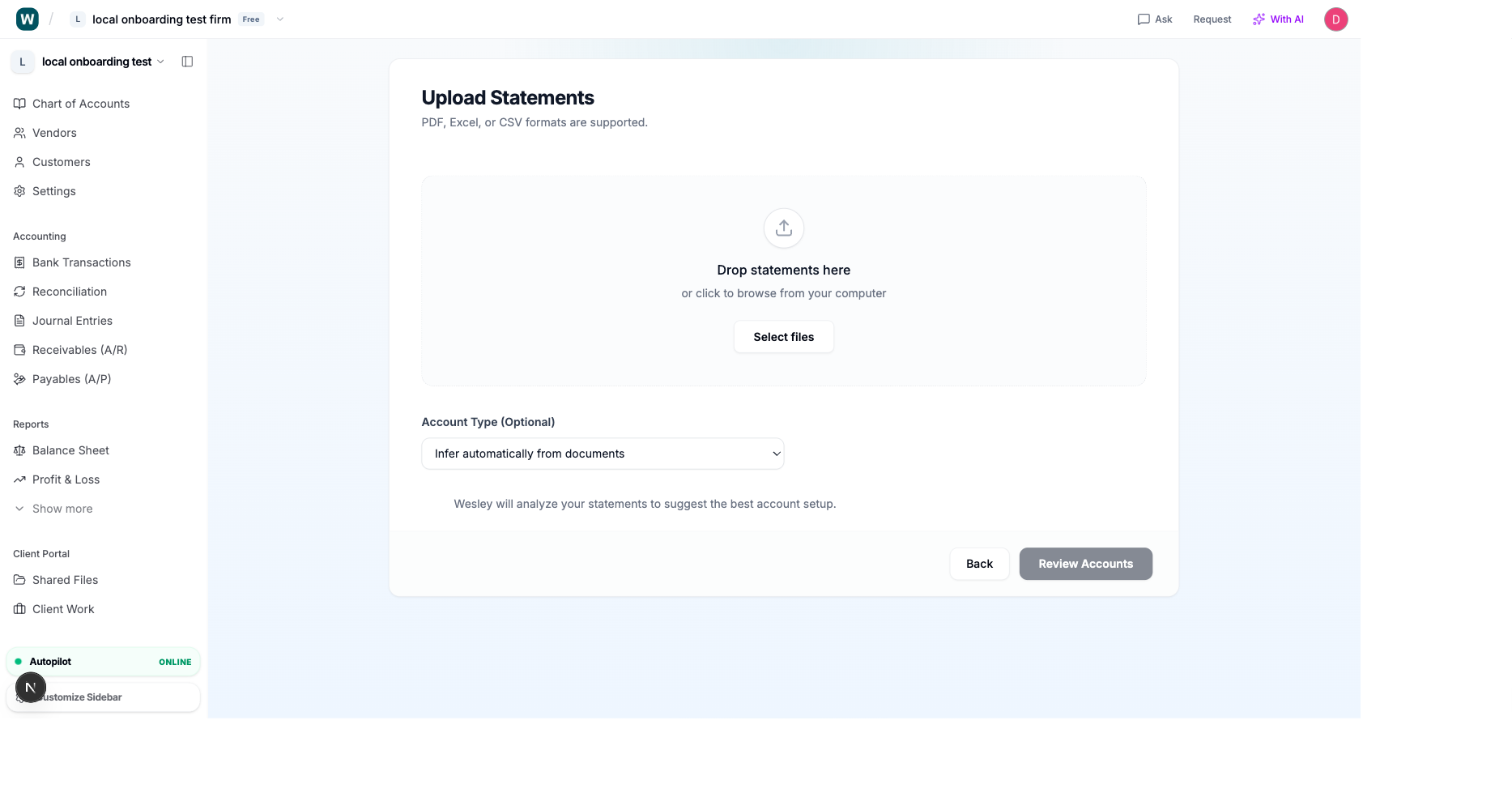
Statement upload kicks off account setup, categorization, and report generation.
A few practical rules make this step stronger:
- upload by account, not as a random pile of PDFs
- keep credit card statements separate from bank statements
- check for missing months first
- do not wait for perfect support if the goal is to get to a fast, tax-ready first pass
For statement-driven cleanup work, speed comes from getting the full year into the system early so the automation can start working immediately.
Step 3: Wesley sets up a tax-ready chart of accounts from bank-statement-first onboarding
This is one of the biggest reasons firms search for bookkeeping cleanup and still end up doing too much manual work. Raw bank data does not automatically become a useful chart of accounts.
Wesley handles that differently. Instead of preserving messy statement labels forever, it begins building a cleaner, more reporting-friendly chart in the background.
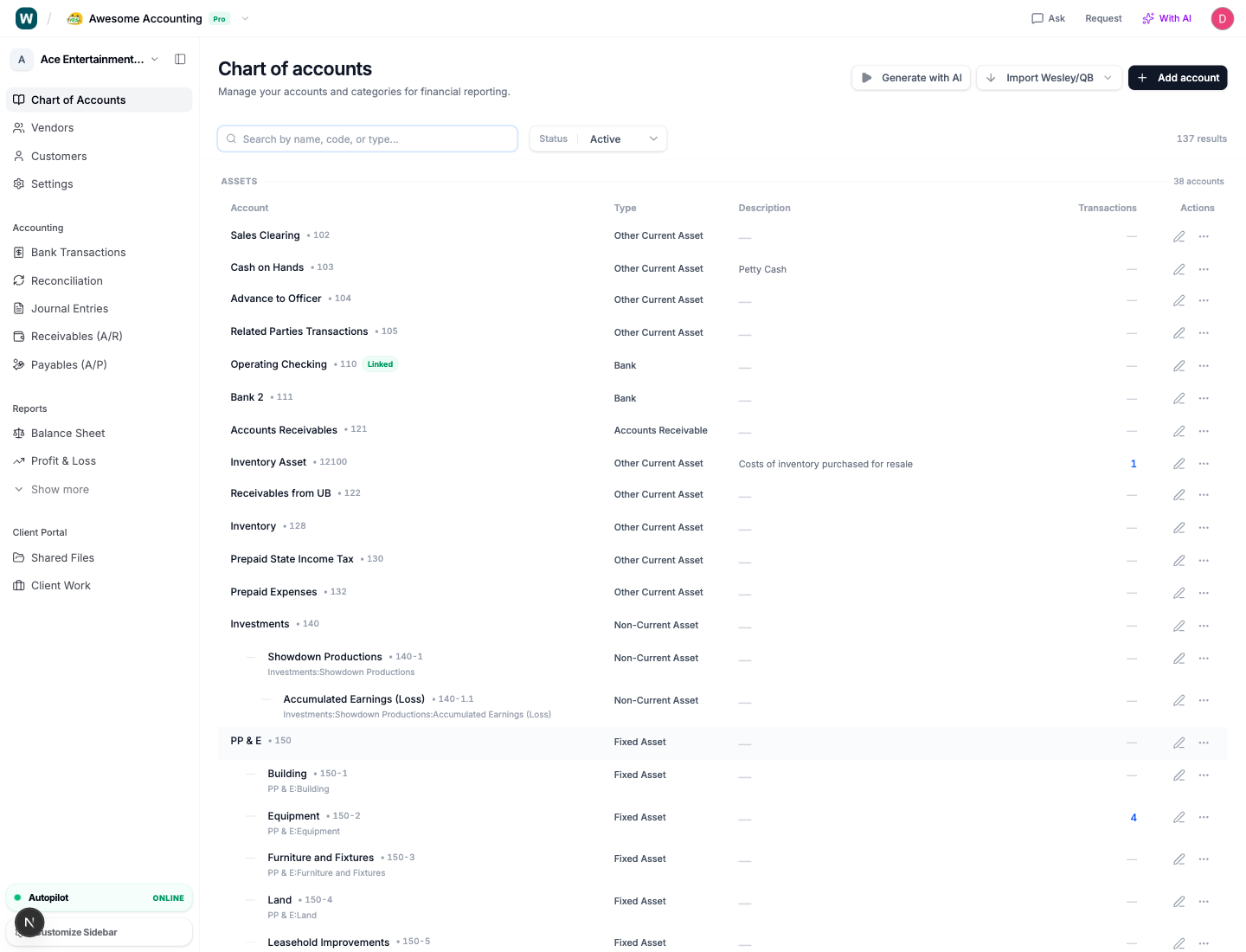
The chart of accounts becomes usable for tax reporting instead of staying tied to raw bank labels.
That means the team can review a structure that is already moving in the right direction:
- operating accounts can be named in a cleaner, reporting-friendly way
- card liabilities can stay separate without exposing raw account identifiers
- transfer-heavy and owner-related activity can be reviewed before it pollutes expense categories
- the account tree becomes easier for a tax preparer to understand
Industry matters here too. A contractor, restaurant, agency, law firm, and ecommerce business should not all end up with the same generic bookkeeping structure. Wesley uses client context and industry context to push the chart toward something more useful for tax reporting and cleanup review.
Step 4: Can you create a profit and loss statement from bank statements alone?
For a straightforward service business or small business cleanup client, the practical answer is yes, if the system does more than store statements.
That is where Wesley helps firms create tax-ready books faster. Once statements are processed, the Transactions Feed becomes the operating center for catch-up bookkeeping.
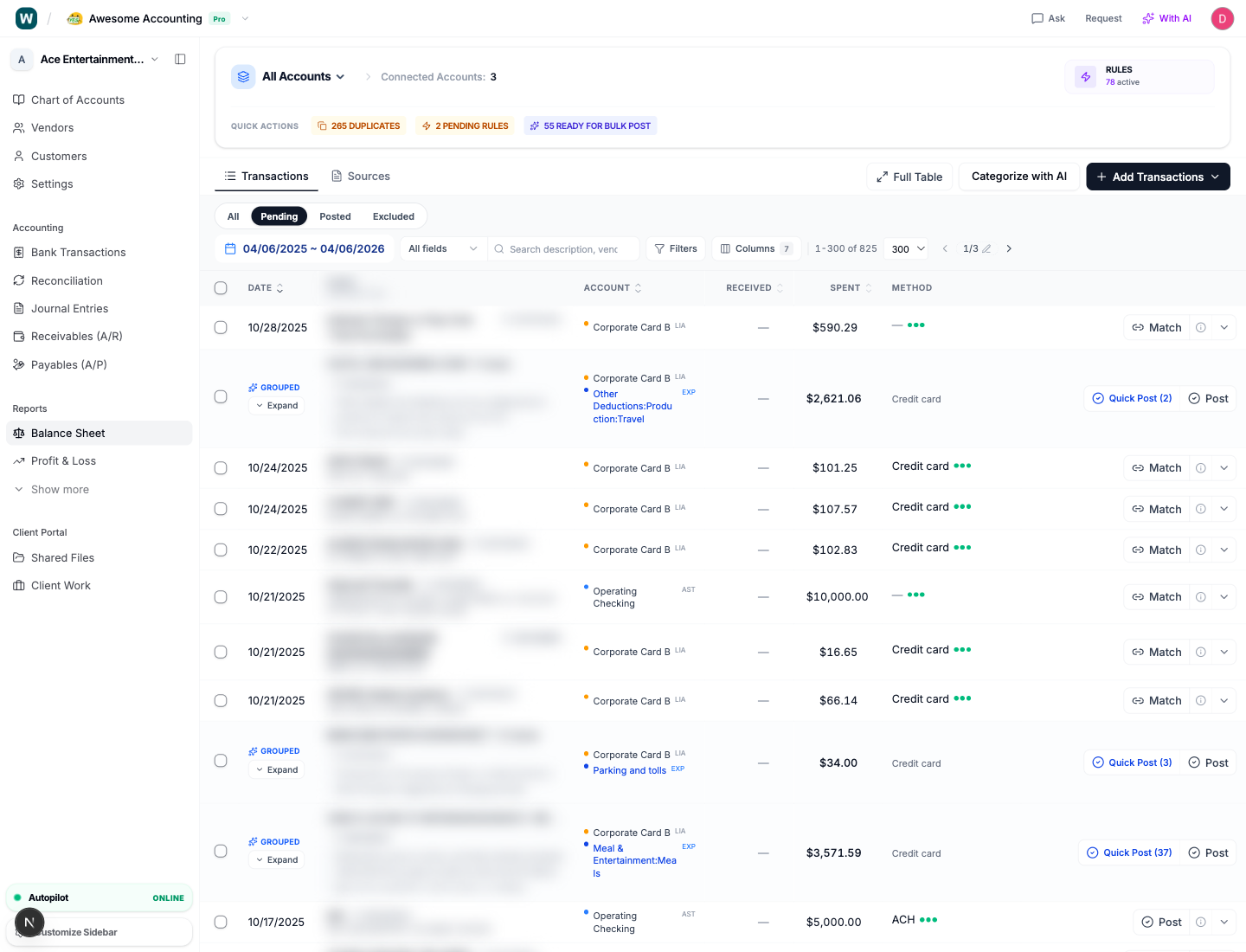
Wesley categorizes most transactions, groups repeat activity, and surfaces quick-post suggestions.
This is where the biggest time savings show up. Wesley does not ask the reviewer to touch every single line. It applies rules, uses source-account context, recognizes repeated activity, and categorizes the majority of transactions with a high level of consistency.
In practice, that means you will often see:
- expense categories already suggested or assigned
- repeat activity grouped together with quick-post behavior
- existing rules carrying categorization consistency forward
- the pending queue narrowed down to the transactions that genuinely deserve review
That changes the job from categorize everything to approve what is obvious and investigate only the real exceptions.
Step 5: What happens when the system cannot categorize a transaction?
A strong bookkeeping system should not pretend every transaction can be auto-classified perfectly. The better system is the one that categorizes most of the volume and isolates only the transactions that actually need judgment.
That is exactly what Wesley does.
When a transaction is too ambiguous to classify confidently, Wesley turns it into a focused work item and makes the missing fact visible.
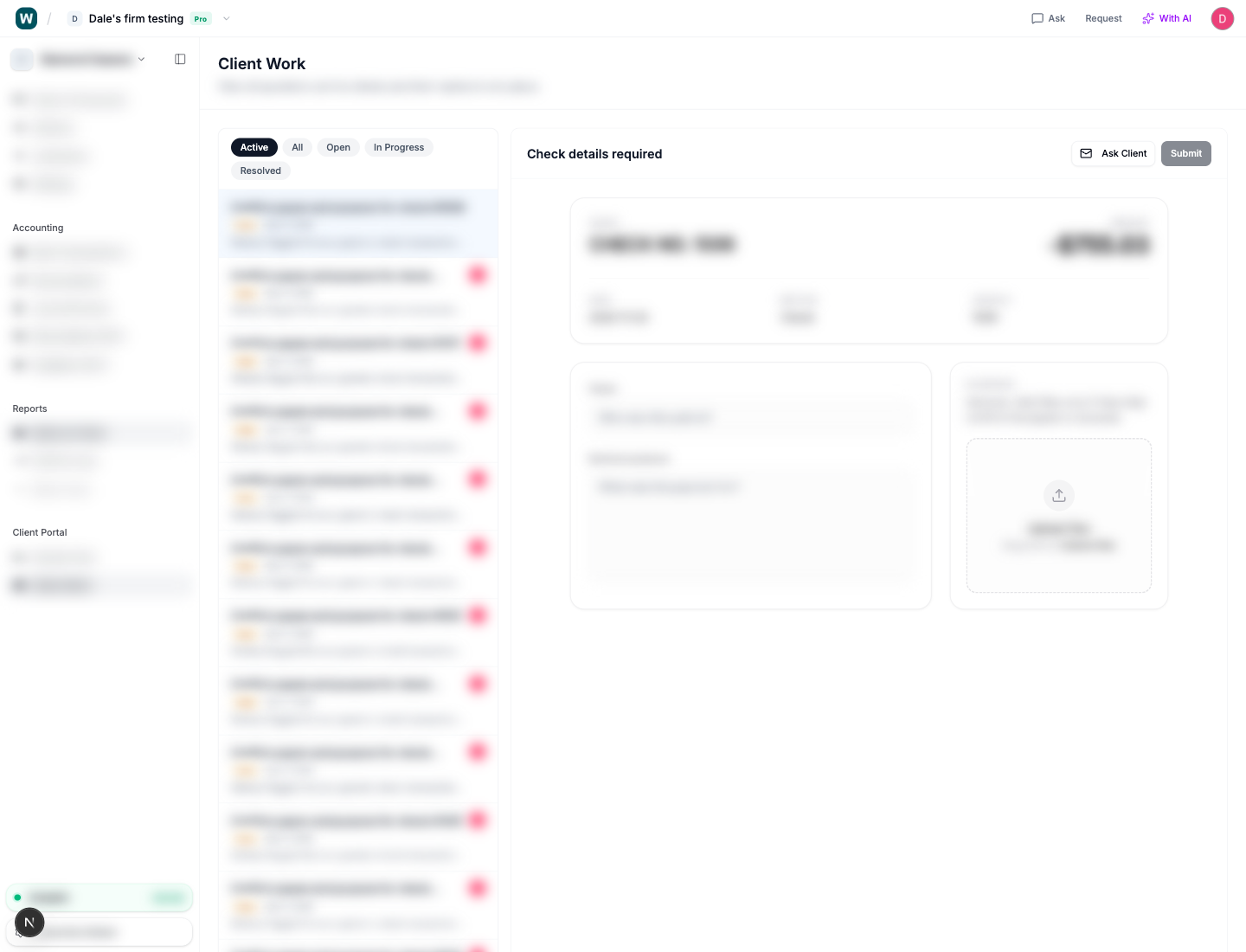
Ambiguous transactions move into Client Work so the team can resolve them or send them back to the client.
Examples include:
- checks with no clear payee
- transactions that need a business purpose
- items that need an invoice, receipt, payee, or supporting explanation
- repeated ambiguous items that should be handled as one issue instead of many separate emails
This matters because the actual user problem is never categorizing a perfectly clean file. The real problem is figuring out what to do with messy transactions when all you have are bank statements.
Step 6: If the bookkeeper already knows the answer, they can resolve it directly
Not every exception needs a client email.
If the reviewer already knows the payee, business purpose, or correct account, they can resolve the transaction directly inside the workflow. That keeps the team moving and prevents unnecessary client back-and-forth.
This is part of why Wesley works well for year-end bookkeeping cleanup. The system does not force manual busywork where human knowledge already exists. It gives the reviewer a structured place to finish the items they already understand.
Step 7: If information is truly missing, Wesley can run the client data chase for you
When the missing detail belongs with the client, Wesley keeps that follow-up inside the bookkeeping workflow. The reviewer can use Ask Client, and the question is sent through the client-follow-up path instead of disappearing into disconnected email threads.
That matters because:
- only true exceptions get escalated to the client
- the question stays attached to the exact transaction context
- the bookkeeping team is not rewriting the same explanation in email over and over
So the workflow becomes simple:
- Wesley categorizes what it can.
- The reviewer clears what they already know.
- Only genuine missing-information items become client follow-up.
That is a much better answer to how to clean up a year's worth of bookkeeping for taxes than a spreadsheet and an inbox full of follow-ups.
Step 8: Review the Profit and Loss and Balance Sheet instead of building them by hand
Once the chart and transactions are in shape, the reviewer can move into the reports.
Profit and Loss Statement
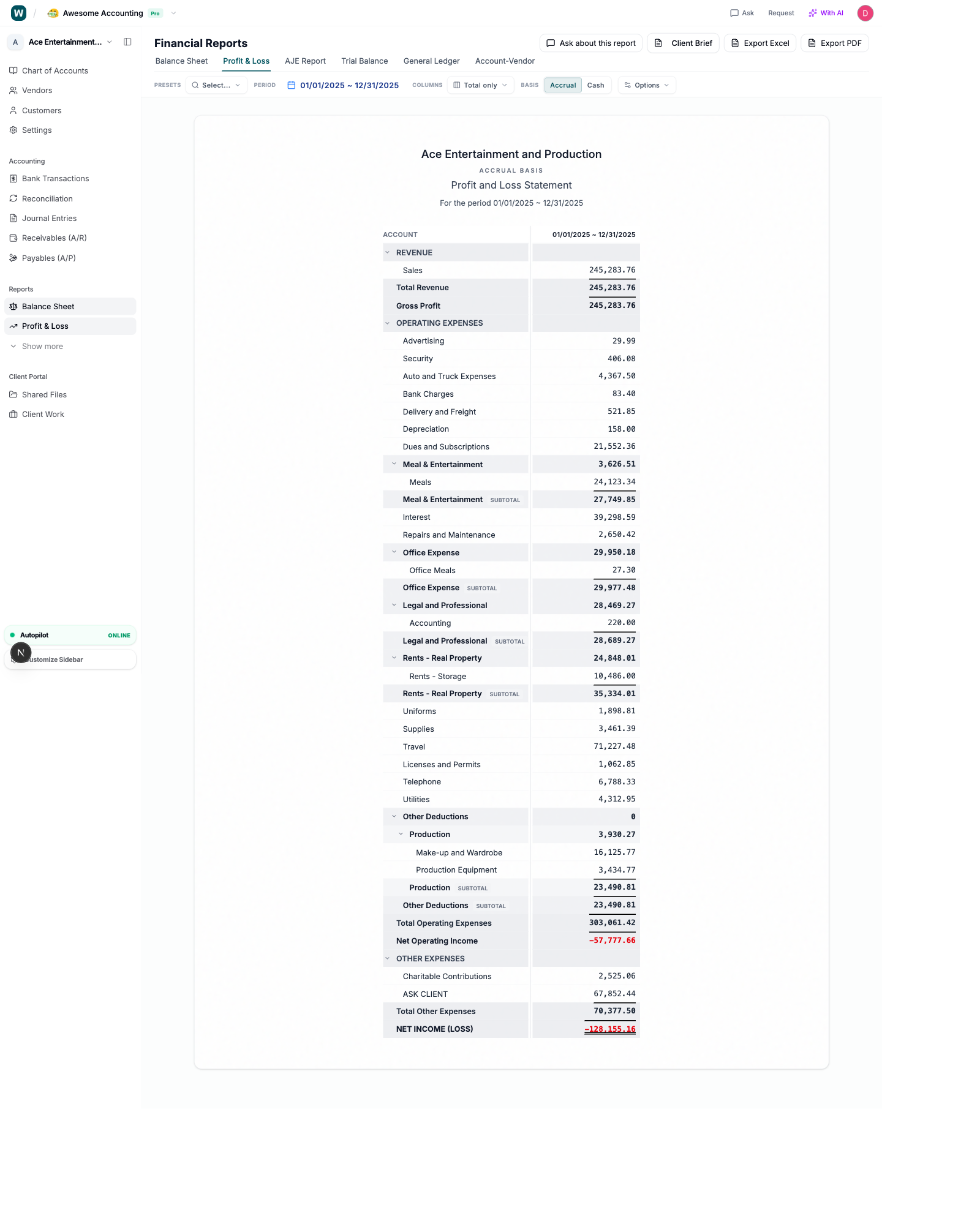
Once the transaction layer is mostly categorized, the P&L becomes a fast review surface instead of a reconstruction project.
At this stage, review whether:
- revenue and major expense buckets look directionally correct
- card payments and card charges were handled correctly
- transfers stayed out of expense categories
- owner-related activity landed where it belongs
- the main tax-sensitive accounts are clean enough for prep
Balance Sheet From Bank Statements
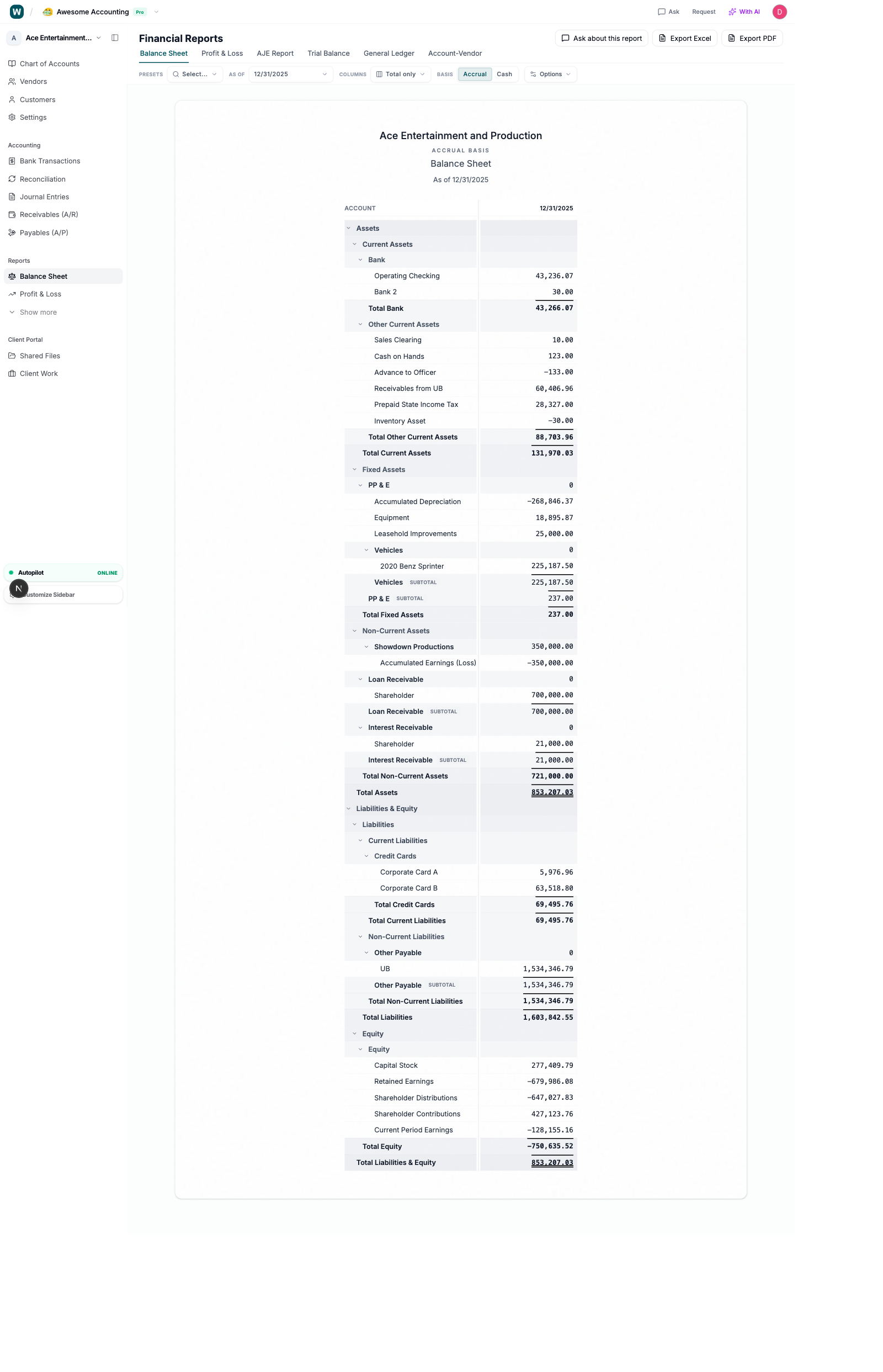
The Balance Sheet is the final quality check for whether the cleanup actually holds together.
This is where you confirm:
- year-end cash looks believable relative to the statements
- card balances remain in liabilities
- equity and opening balances do not look broken
- remaining odd balances are small enough to understand and explain
When Wesley has already shaped the chart, categorized most transactions, and isolated the exceptions, the reports become a review task instead of a rebuild.
A 60-Minute Catch-Up Bookkeeping Workflow in Wesley
Here is what the one-hour version looks like for a straightforward statement-driven client using Wesley for tax-season cleanup.
| Time | What happens in Wesley | Why it is fast |
|---|---|---|
| 0-10 minutes | Open the client in orgs, confirm the period, and choose Start Fresh | The cleanup is scoped before review starts |
| 10-20 minutes | Upload the full year of bank and card statements | Wesley starts shaping accounts and ingesting activity immediately |
| 20-30 minutes | Review the chart of accounts and clean up obvious account naming | You get a report-ready structure without building the chart from zero |
| 30-45 minutes | Review the Transactions Feed, approve quick posts, and clear known exceptions | Most of the work becomes review instead of manual categorization |
| 45-55 minutes | Send only the real missing-information items to the client | Data chase stays narrow and attached to the transaction |
| 55-60 minutes | Review the Profit and Loss and Balance Sheet | Final report review replaces manual reconstruction |
Why This Workflow Gets You to Tax-Ready Books Faster
Firms do not lose time only because transactions are messy. They lose time because the work is fragmented.
- the chart of accounts gets built too late
- transaction review becomes repetitive
- missing-information follow-up happens outside the bookkeeping system
- report review waits until the cleanup is almost over
Wesley shortens all four.
- The chart starts forming as soon as the bank data comes in.
- Most transactions are categorized before a human reviews them.
- Ambiguous items become explicit work packets instead of vague bookkeeping discomfort.
- Client follow-up stays attached to the bookkeeping context.
That is why Wesley is effective for tax-ready books, not just faster document collection.
Who This Workflow Fits Best
This is especially effective for:
- annual write-up clients who show up during tax season with a full year of statements
- statement-driven small businesses with one or two bank accounts and a few cards
- cleanup projects where the firm needs a fast first pass before tax prep
- firms that want to reduce client chase happening outside the bookkeeping system
It is not the full answer for every edge case. Complex A/R, A/P, payroll accruals, inventory, fixed assets, or multi-entity work may still need a second accounting pass. But Wesley is a strong first-pass engine for the exact kind of cleanup work that clogs tax season.
FAQ
How do you do catch-up bookkeeping from bank statements?
The fast path is to bring in the full year of statements, build a usable chart of accounts, categorize the majority of transactions, isolate only the exceptions, and review the final reports. That is the workflow Wesley is designed to run.
Can you create a profit and loss statement from bank statements?
Yes, for the right kind of small business cleanup client. The key is using a system that converts statement data into categorized bookkeeping activity instead of leaving it as raw documents.
Can you create a balance sheet from bank statements?
You can create a practical first-pass Balance Sheet when cash, card liabilities, transfers, and categorization are handled correctly. The report still needs review, but the heavy lifting can be automated.
What is the fastest way to get tax-ready books for a small business?
The fastest route is to avoid row-by-row manual cleanup. A bank-statement-first workflow that shapes the chart of accounts, categorizes most transactions, and escalates only true exceptions is much faster.
What if some transactions are unclear or missing backup?
Wesley turns those items into structured work packets. If the reviewer already knows the answer, they can resolve it directly. If not, they can use Ask Client to send a focused follow-up tied to the transaction itself.
Final Takeaway
A firm needs catch-up bookkeeping. The client only has bank statements. The team needs tax-ready books fast. And someone still has to produce a Profit and Loss and Balance Sheet without wasting days on manual cleanup.
That is what Wesley helps firms do. It turns raw statements into a tax-ready bookkeeping workflow by setting up the chart of accounts, categorizing most transactions, isolating the ambiguous items, and keeping client follow-up inside the system.
By the time the reviewer opens the reports, they are reviewing financials instead of building them from scratch.
Ready to use the matching workflow?
Bank statement to CSV converter
Start from the general statement-conversion workflow.
Related reads
Discover adjacent articles without being sent to near-duplicate topics.


