Bank Reconciliation Automation for Accountants: How to Catch Statement Mismatches Earlier

Searches for bank reconciliation automation for accountants usually pull up close-management tools, spreadsheet templates, or generic bank-feed software.
That misses the real pain for many accounting firms.
The hard part is not just checking a box that says “reconciled.” The hard part is catching balance mismatches early, tracing missing periods, and figuring out whether the source problem is in the books, the statement, or the imported activity.
Wesley is useful here because it treats reconciliation as part of the bookkeeping workflow, not a disconnected month-end checklist.
The adjacent market is improving reconciliation, but often from the wrong starting point
Products around the category are pushing in the right direction:
- FloQast Reconciliation Automation emphasizes standardized workflows, centralized documentation, and clearer ownership.
- Enterprise close tools are good at process management once the underlying accounting data is already mostly stable.
- Other bookkeeping tools often focus on bank feeds, but leave firms to diagnose mismatches manually.
The missing piece for many firms is a workflow that starts with client-level bookkeeping data, not only the controller’s close checklist.
That is the gap Wesley fills.
Coverage and resources
Open the authority pages that support this workflow.
Supported banks
See which institutions have dedicated coverage pages and where statement fallback still makes sense.
Open page →
Supported statement types
See which source documents Wesley can clean up before export or import prep.
Open page →
Bank Statement Cleanup SOP for Bookkeepers
A bank statement cleanup SOP for bookkeepers who need a repeatable review process before exporting to QuickBooks, Xero, QIF, or spreadsheet workflows.
Open page →
Month-End Close Request Checklist for Accounting Firms
A practical month-end close request checklist you can send to clients so statements, loan docs, payroll reports, and exception support arrive before the close starts.
Open page →
What reconciliation automation should actually help with
For an accounting firm, reconciliation automation should make it easier to:
- choose the exact external account being reconciled,
- compare opening and closing balances against booked activity,
- preview the expected ending balance before final confirmation,
- spot missing periods that distort the comparison,
- upload statement evidence when a specific month needs drilldown.
If a tool cannot help with those steps, it is not really reducing reconciliation work. It is only documenting the pain more neatly.
Wesley makes reconciliation part of the same bookkeeping system
Instead of sending staff into a spreadsheet detour, Wesley keeps reconciliation inside the client workflow.
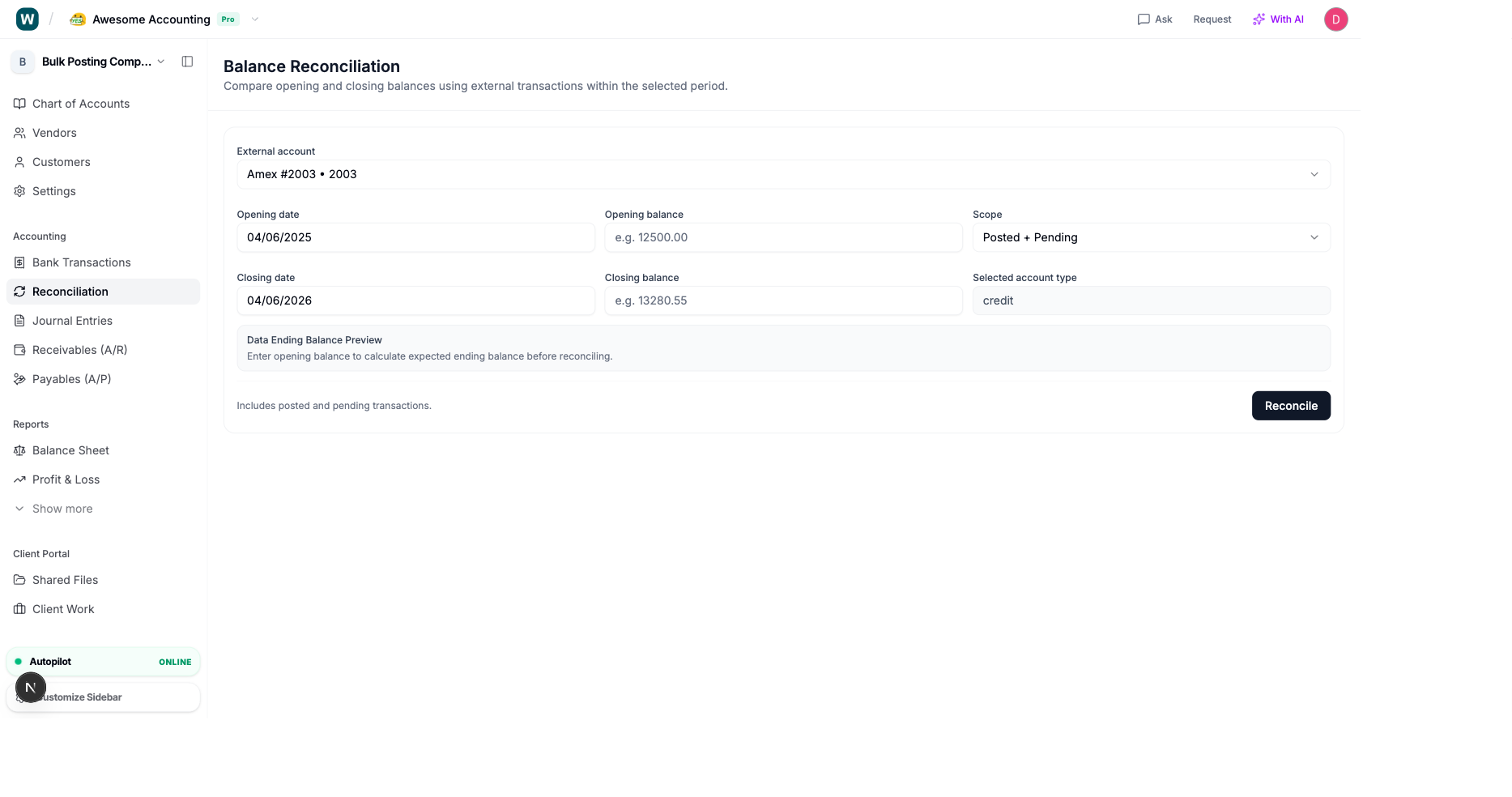 The form is not the point. The point is that reconciliation happens in context, against the real transaction data and account scope the team is already using.
That matters because reconciliation is often where upstream bookkeeping issues finally become visible:
- uncategorized transactions,
- missing imported periods,
- duplicated activity,
- incorrect opening balances,
- or statement timing mismatches.
Reconciliation gets easier when the transaction workflow upstream is cleaner
This is one reason generic reconciliation advice falls short. Reconciliation is downstream of transaction hygiene.
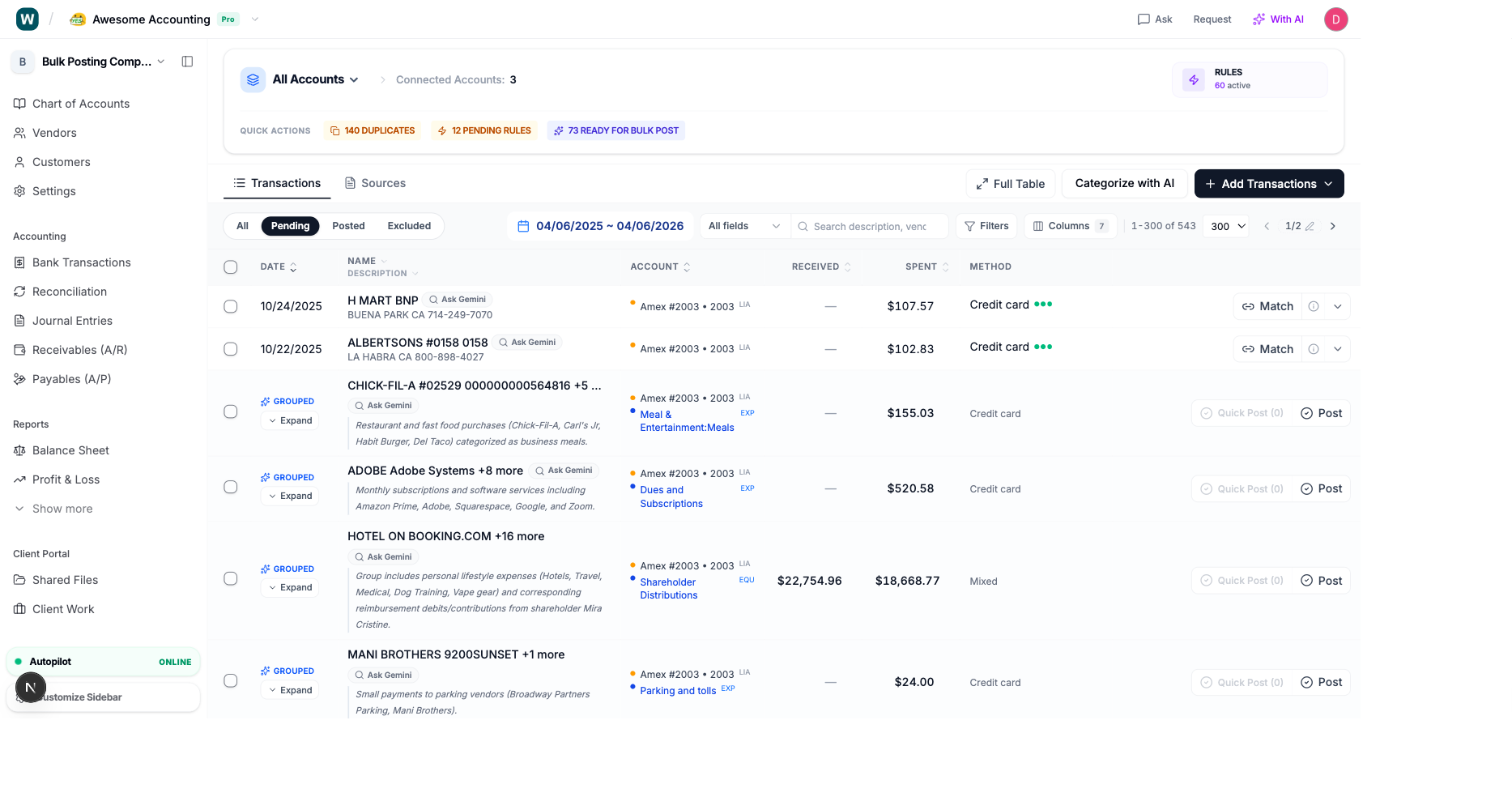 Cleaner first-pass transaction work means fewer unexplained differences when the firm reaches reconciliation.
When repetitive transaction work is more structured, the reconcile step becomes faster because the reviewer is not trying to solve three problems at once:
- transaction cleanup,
- statement comparison,
- and missing-context investigation.
A practical advantage: reconciliation can point to root causes earlier
The Wesley reconciliation flow is designed around signals that matter to an accounting firm:
- expected ending balance preview,
- missing-period overlap warnings,
- month-by-month mismatch identification,
- and statement-file analysis for drilldown.
That is more useful than a generic “difference exists” message, because it tells the team where the next action should be.
Positioning: Wesley is not just close software, and not just bank-feed software
This is where Wesley is positioned differently from adjacent products:
- close-management tools are strongest at standardized sign-off processes,
- bookkeeping automation tools are strongest at data capture,
- Wesley connects reconciliation to the same system that handles categorization, review, and reporting.
That means the reconciliation use case is not isolated. It is part of a broader bookkeeping operating loop.
Why this matters for accounting-firm capacity
Reconciliation delays are expensive because they block everything downstream:
- final review,
- report confidence,
- tax-prep readiness,
- and client delivery.
When the firm catches mismatches earlier, reviewers spend less time doing forensic work late in the cycle.
That is why reconciliation automation is not only a controls story. It is a margin story.
FAQ
What is bank reconciliation automation for accountants?
It is software that reduces the manual work of comparing recorded activity to external balances and helps identify why differences exist.
Why is spreadsheet reconciliation still so common?
Because many systems still leave the actual mismatch analysis to the accountant, even if they provide bank feeds or close checklists.
What makes Wesley useful for reconciliation?
Because Wesley keeps reconciliation tied to the same transaction and reporting system the firm is already using, instead of pushing the team into a disconnected side workflow.
Does reconciliation automation replace review judgment?
No. The best outcome is faster identification of the likely problem, so the reviewer can apply judgment where it matters most.
Want faster review loops?
Test AI-assisted categorization without losing reviewer control
Use Wesley to surface suggested accounts, confidence signals, and manual overrides in one place so your team can move faster without blind posting.
Related reads
Discover adjacent articles without being sent to near-duplicate topics.

