How to Ask Clients About Missing Transaction Details Without Email Chaos

Missing Transaction Details Usually Turn Into an Email Problem Before They Become an Accounting Problem
Accounting firms rarely search for a better way to email clients just for fun. They search because month-end close slows down when transactions are missing a payee, missing a business purpose, or missing backup.
That is why queries like ask clients about transactions, missing transaction details, how to ask clients for receipts, and bookkeeping client follow-up keep showing up. The real problem is not writing the email. The real problem is keeping the question tied to the exact transaction so the team can close the books faster.
That is the workflow Wesley is designed to improve. Wesley helps accounting firms identify which transactions truly need more information, resolve what the reviewer already knows, and send the remaining questions into a structured client workflow instead of another messy email chain.
Coverage and resources
Open the authority pages that support this workflow.
Supported banks
See which institutions Wesley already covers and when statement fallback still matters.
Open page →
Integrations hub
See where Wesley fits before QuickBooks, Xero, QIF, Sage, and NetSuite workflows.
Open page →
Template library
Use saveable SOPs and checklists alongside the workflow pages.
Open page →
What Counts as a Missing Transaction Detail?
A missing transaction detail is any fact the reviewer still needs before posting the transaction confidently.
That usually means one of five things:
- the payee is unclear
- the business purpose is missing
- a check has no usable memo information
- the reviewer needs a receipt or invoice
- the bank description is too vague to classify correctly
When firms do not have a clean follow-up process, those items pile up, delay close, and create a second workflow outside the books.
Use Client Work to Separate Real Exceptions From Reviewer Guesswork
The fastest client-follow-up workflow starts by not asking the client about everything.
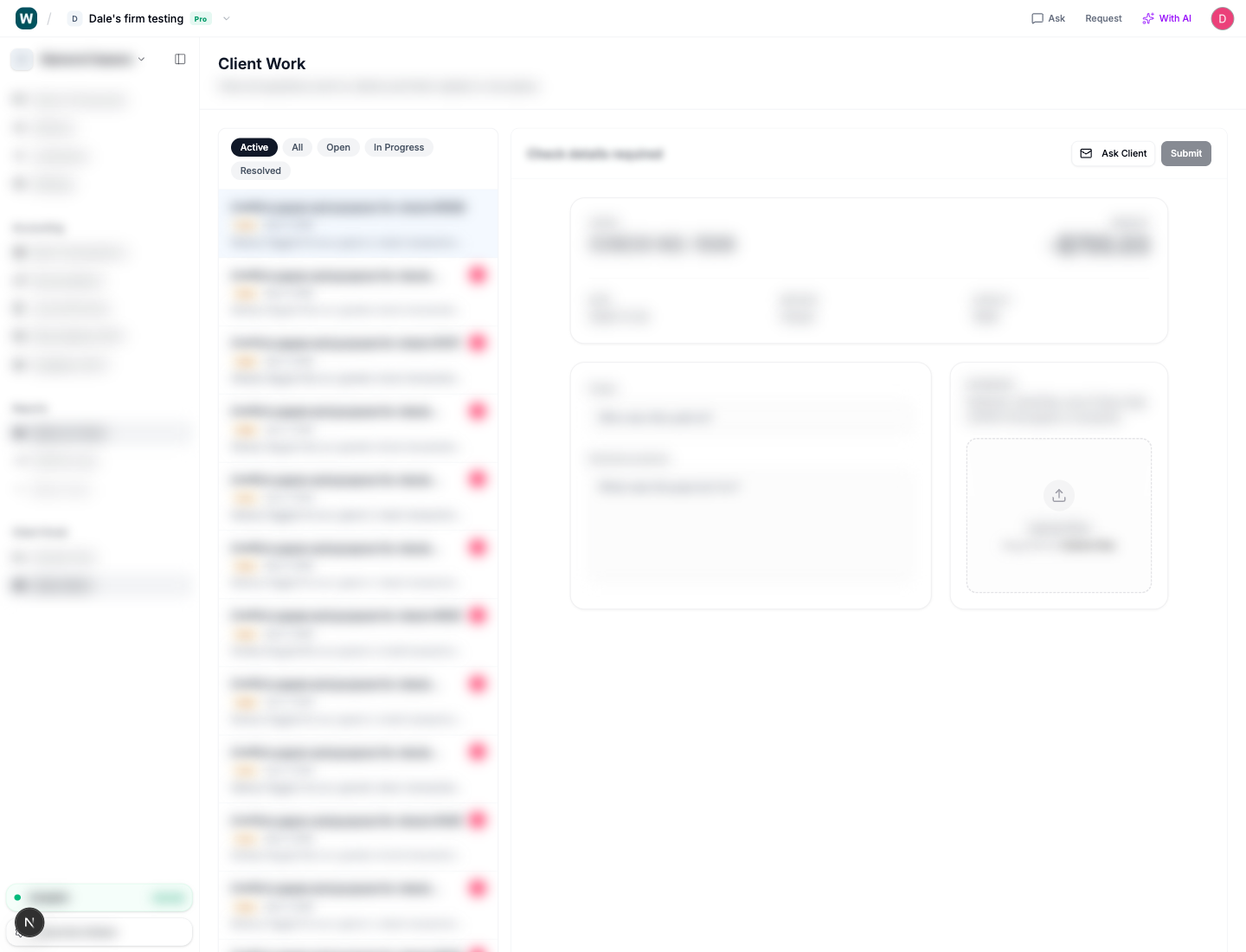
Client Work turns vague transaction uncertainty into a visible list of review items so the team can decide what to resolve internally and what to send back to the client.
This is the first operational win. A reviewer should not chase the client for transactions the system already understands well enough or that the reviewer already knows how to resolve.
That is why Wesley works well for accounting-firm review workflows. The system helps the team:
- keep unresolved items in one place
- avoid broad bookkeeping email threads
- separate internal decisions from true client-dependent exceptions
- keep the accounting context close to the original transaction
The fewer unnecessary questions the client gets, the better the response rate usually becomes.
Why Email Threads Break the Missing-Information Workflow
A traditional bookkeeping follow-up usually looks like this:
- A reviewer notices an unclear transaction.
- They copy the details into email or chat.
- The client replies later with partial context.
- Someone has to match that answer back to the correct transaction.
- The team repeats the same loop across multiple items.
That process is slow because the bookkeeping context gets detached from the question. It also creates more work for the reviewer, because every answer has to be reattached manually.
Wesley keeps the client question inside the bookkeeping workflow, which is the real difference.
Use Ask Client When the Missing Fact Actually Lives With the Client
When the reviewer genuinely needs client input, Wesley gives the team a more structured way to ask.

Ask Client can trigger a portal invite and send the follow-up through a controlled workflow instead of another disconnected email chain.
That changes the follow-up pattern in a useful way:
- the team escalates fewer items
- the client sees a focused request instead of a long bookkeeping email
- the answer stays closer to the transaction that triggered it
- the reviewer can move from question to resolution faster
If your firm keeps asking how to ask clients about unclear transactions without losing context, Wesley provides that operating layer.
What Should You Actually Ask the Client?
The best bookkeeping follow-up questions are narrow and easy to answer.
Examples:
- What was this check for?
- Who was the payee on this transaction?
- Was this charge personal or business?
- Can you upload the invoice or receipt for this item?
- Was this transfer owner-related, reimbursement-related, or business-related?
The point is not to sound formal. The point is to reduce ambiguity. A good transaction question asks for the exact fact that will unblock posting.
Resolve Known Items Directly So the Client Only Sees the Real Exceptions
A strong workflow does not ask the client about every ambiguous-looking line. If the reviewer already knows the vendor, the pattern, or the right account based on prior activity, they should resolve it directly.
That matters because client communication should be reserved for genuine missing information, not reviewer uncertainty that can be solved internally.
This is another reason Wesley helps reduce bookkeeping email chaos. It supports both sides of the workflow:
- reviewer resolution when the accounting team already knows enough
- client follow-up when the answer truly lives with the client
A Better Workflow for Asking Clients About Transactions
Here is the practical version.
| Step | What happens | Why it is better |
|---|---|---|
| 1 | The team keeps unresolved items inside Client Work | Questions stay connected to bookkeeping context |
| 2 | Reviewers clear what they already know | Internal knowledge stays internal |
| 3 | Real exceptions are scoped before anything goes out | Clients only see the transactions that truly need input |
| 4 | Ask Client is used for narrow follow-up | The request stays specific and actionable |
| 5 | Answers come back into an organized workflow | The team can resolve faster and close sooner |
That is the kind of process Wesley helps accounting firms run when transaction review and client communication need to happen together.
FAQ
How do you ask clients about missing transaction details?
Ask a narrow question tied to one specific transaction, such as payee, business purpose, or requested backup. The key is keeping that question connected to the bookkeeping context.
What is the best way to ask clients about unclear transactions?
The best way is to avoid broad bookkeeping emails and send focused requests only for real exceptions. A structured workflow works better than free-form email.
Should bookkeepers ask the client about every unclear transaction?
No. The team should resolve what it already knows and escalate only the items where the missing fact actually lives with the client.
Why do missing transaction details slow down month-end close?
Because the delay is usually not the transaction itself. It is the follow-up cycle, the missing context, and the time spent reconnecting client answers to the correct items.
Final Takeaway
If your firm is searching for a better way to ask clients about missing transaction details, the goal should not just be better email wording. The goal should be a better operating workflow.
That is where Wesley helps accounting firms. It reduces unnecessary client questions, helps reviewers clear what they already know, and gives the team a structured Ask Client path for the transactions that truly need outside information.
That is how firms reduce email chaos, resolve review items faster, and get cleaner books out the other side.
Want faster review loops?
Test AI-assisted categorization without losing reviewer control
Use Wesley to surface suggested accounts, confidence signals, and manual overrides in one place so your team can move faster without blind posting.
Related reads
Discover adjacent articles without being sent to near-duplicate topics.