AI Bookkeeping Software for Accountants: What AI Transformation Should Actually Look Like at an Accounting Firm

Search interest in AI bookkeeping software for accountants keeps growing, but most firms still run into the same problem:
they buy one tool for document capture, another for close management, another for client follow-up, and still do the real bookkeeping cleanup manually.
That is not transformation. It is tooling sprawl.
If you are evaluating how AI should actually change an accounting firm, Wesley is worth looking at because it is designed around the operational bottlenecks that firms deal with every day: backlog triage, transaction categorization, review queues, and getting from raw data to financial statements faster.
What the adjacent market is getting right, and where the gap still is
Several adjacent products are pushing the market forward:
- FloQast positions itself as an Accounting Transformation Platform powered by AI agents, with messaging centered on automating workflows and elevating preparers into reviewers.
- Dext positions around automated bookkeeping software for accountants, especially document capture and extraction.
- Bench and other SMB-facing bookkeeping services package ongoing bookkeeping and tax preparation, but they are not built around the accounting-firm multi-client workflow.
Those products are useful reference points. But the core gap for firms is still this:
How do you apply AI inside the actual bookkeeping operating system of the firm, not just around the edges?
That is where Wesley is different.
Coverage and resources
Open the authority pages that support this workflow.
Supported banks
See which institutions Wesley already covers and when statement fallback still matters.
Open page →
Integrations hub
See where Wesley fits before QuickBooks, Xero, QIF, Sage, and NetSuite workflows.
Open page →
Template library
Use saveable SOPs and checklists alongside the workflow pages.
Open page →
What AI transformation should actually mean for an accounting firm
A good AI workflow should do four things:
- show the firm where the real backlog is,
- automate repetitive first-pass work,
- leave high-risk exceptions visible for review,
- move the file toward a usable P&L and balance sheet faster.
That is the practical definition of transformation. Not more dashboards. Not more disconnected assistants. Just less manual prep and more controlled review.
Wesley starts at the firm portfolio level, not just inside one client file
One reason AI rollouts fail is that firms start too deep in the workflow. They automate transaction coding before they have a good way to see which clients are actually putting pressure on the team.
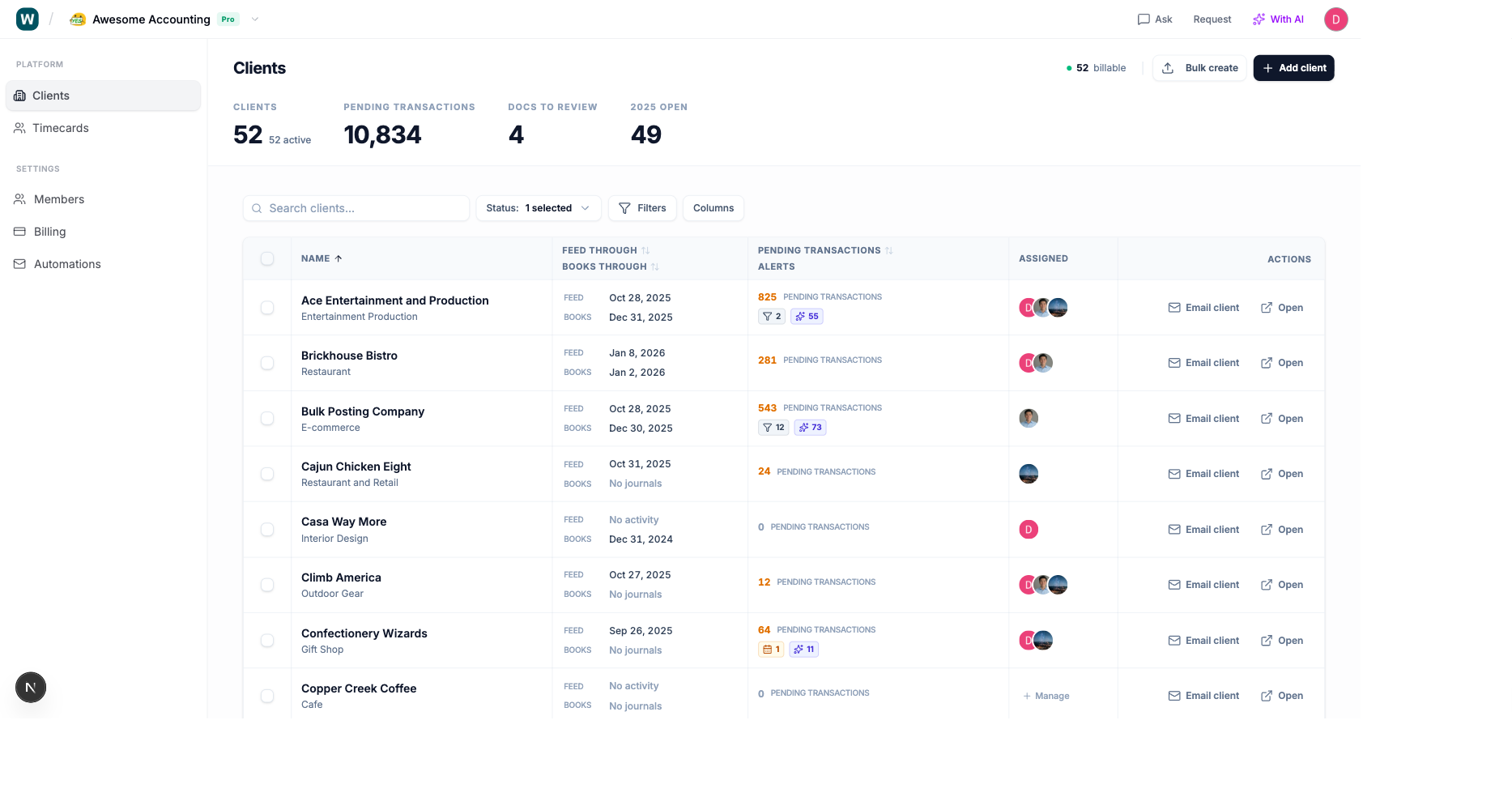 The transformation opportunity starts with visibility. Firms need to know where backlog, review pressure, and open tax work are sitting right now.
At the portfolio level, Wesley helps the firm answer questions like:
- which clients have the most pending transactions,
- which clients are still open for tax work,
- where document review is building up,
- which files need attention first.
That matters because AI should change who the team works on next, not only how one transaction gets coded.
Then it applies AI where accounting firms actually lose time
The next margin leak is repetitive transaction work. That is where firms waste reviewer time on work that should never reach the reviewer in raw form.
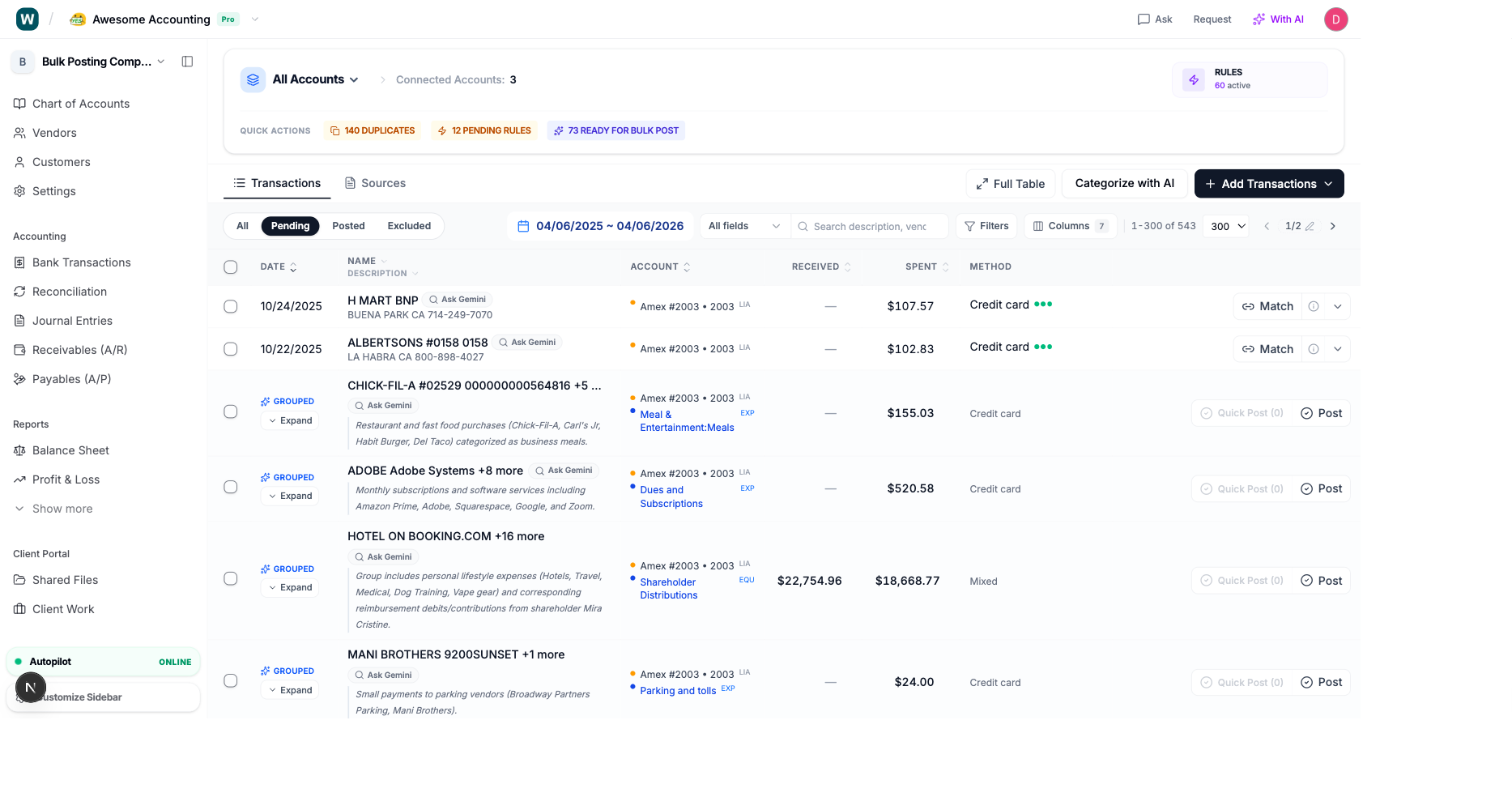 This is where AI is most valuable: repetitive first-pass cleanup, grouped suggestions, and narrowing the work that actually needs judgment.
Instead of forcing the team to manually touch every row, Wesley is built to:
- identify duplicates,
- surface pending rules,
- group repeat transactions,
- suggest accounts consistently,
- and shorten the path to bulk posting.
That is a better AI transformation story than “AI will do accounting for you.” It is AI making reviewable accounting work appear faster.
The target state is not auto-posting everything blindly
Dext’s own messaging emphasizes using AI while staying in control. That is the right framing. Accounting firms do not need blind automation. They need confidence that repetitive work is compressed while exception handling stays visible.
That is also how Wesley is positioned:
- the AI handles pattern-heavy work,
- the reviewer still controls final judgment,
- the operating surface remains auditable and practical.
Transformation should end in reports, not just categorized rows
The real test of whether AI helped is not whether a queue looks cleaner. It is whether the firm can move into financial review sooner.
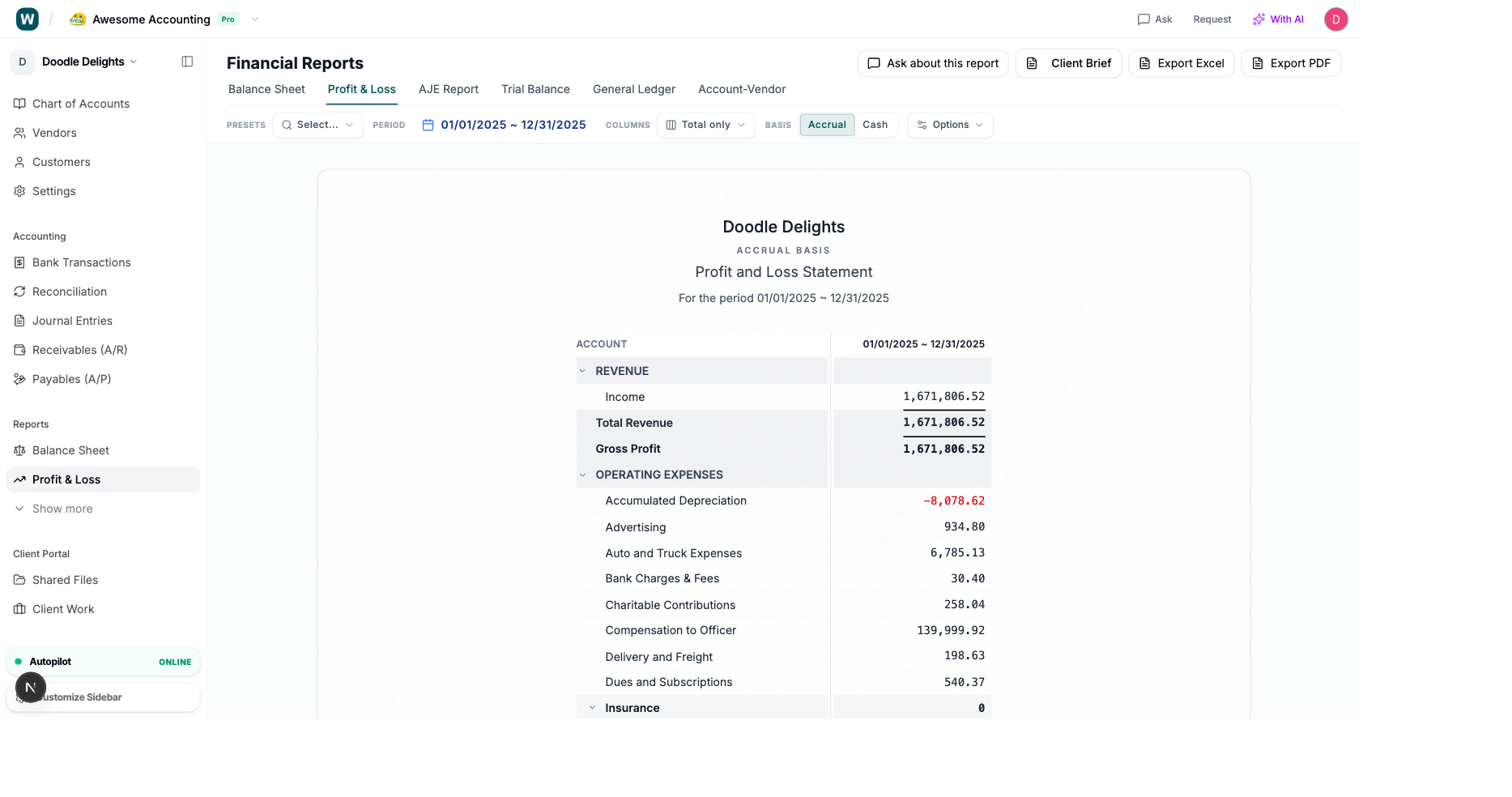 The output that matters is a report the reviewer can use, not just a prettier task list.
When the product shortens the path from raw activity to a usable P&L, it changes the economics of the engagement:
- preparers spend less time on manual cleanup,
- reviewers spend more time on real accounting decisions,
- firms can absorb more work without expanding headcount at the same rate.
How Wesley is positioned differently from adjacent tools
The simplest way to understand Wesley is this:
- FloQast is close-process transformation,
- Dext is document capture and extraction,
- SMB bookkeeping services are outsourced execution,
- Wesley is AI bookkeeping operations for accounting firms.
That means:
- portfolio visibility,
- client-by-client transaction workflows,
- review-friendly categorization,
- tax-ready reporting outputs,
- and tighter linkage between operations and the actual books.
FAQ
What is AI bookkeeping software for accountants supposed to automate?
The best target is repetitive first-pass work: triage, categorization, rule application, duplicate detection, and exception isolation.
Will AI replace bookkeepers at accounting firms?
No. The more realistic outcome is that AI moves more of the team from raw preparation into controlled review, exception handling, and client-facing analysis.
What does AI transformation in accounting firms actually look like?
It looks like fewer manual touches per file, clearer portfolio prioritization, faster first-pass cleanup, and quicker movement into usable financial reports.
Why is Wesley a strong fit for this use case?
Because Wesley is built around the accounting-firm workflow itself, not only one narrow layer like document capture or enterprise close checklists.
Try Wesley next
See whether this workflow fits your books
Book a demo, review the workflow with Wesley, and evaluate the fit before asking your team to change how they work.
Related reads
Discover adjacent articles without being sent to near-duplicate topics.


