Accounting Firm Burnout: How to Reduce Review Queues, Client Chasing, and Manual Cleanup

Accounting firm burnout is usually an operations problem before it is a morale problem
When firm owners search accounting firm burnout, accountant burnout, CPA burnout, burnout during tax season, or how to reduce burnout in accounting firms, they are usually not looking for another generic productivity talk.
They are trying to fix a delivery system that keeps dumping more manual review work on the same people.
Burnout in accounting firms usually shows up as a workflow pattern:
- too many pending transactions across too many clients
- seniors spending time on repetitive cleanup instead of high-value review
- staff chasing basic client answers one item at a time
- inbox follow-ups scattered across different places
- month-end and tax-season work turning into context switching instead of forward motion
Wesley for accounting firms is useful here because it is built around the real sources of bookkeeping overload: queue visibility, grouped transaction handling, exception review, and client follow-up.
Choose your workflow
Tax workflow hub
The full cluster for W-9 collection, 1099 review, and filing-season cleanup workflows.
Collect a W-9 before filing a 1099
The cleanest timing and follow-up workflow before filing season turns reactive.
1099-K vs 1099-NEC
How to separate processor-reported payments from contractor compensation.
Why a contractor is missing from your QuickBooks 1099
A practical troubleshooting flow for inactive vendors, thresholds, and mapping issues.
Why credit card payments do not show up on 1099s
The exact reporting logic behind excluded card and payment-app transactions.
Coverage and resources
Open the authority pages that support this workflow.
Supported banks
See which institutions Wesley already covers and when statement fallback still matters.
Open page →
Integrations hub
See where Wesley fits before QuickBooks, Xero, QIF, Sage, and NetSuite workflows.
Open page →
Template library
Use saveable SOPs and checklists alongside the workflow pages.
Open page →
Why accounting teams burn out during busy periods
The hours matter, but the real drag is not just volume. It is fragmented volume.
A team can survive a busy week when work is structured. What burns people out is when the same reviewer has to:
- open client after client just to figure out where the backlog is
- read the same kind of transaction over and over
- ask for missing information one exception at a time
- move between spreadsheets, email, and the books just to keep context straight
That is why searches like bookkeeping burnout, accounting workload management, tax season burnout accounting, and accountant burnout automation are really operational searches. Firms want fewer low-leverage clicks and less mental load per client.
Make overload visible before it turns into burnout
One of the fastest ways to reduce accounting firm burnout is to make backlog visible at the portfolio level.
On the clients view, Wesley surfaces firm-wide counts like pending transactions and also shows the per-client load in the table itself. That matters because burnout grows when managers discover work too late. If one client has a much heavier queue than the rest of the portfolio, the team needs to see that immediately, not after somebody is already underwater.
That kind of visibility changes staffing decisions, review planning, and client communication. It also helps partners and managers spot where overload is building before it becomes a fire drill.
Turn repetitive transaction review into grouped decisions and bulk posting
Individual transaction review is one of the biggest hidden causes of accountant burnout. A senior bookkeeper may be able to classify a single transaction quickly, but doing that across dozens or hundreds of near-identical items creates review fatigue.
In Wesley's Transactions Feed, similar items are grouped, the system explains the recommended treatment, and the firm can quick post grouped sets instead of clicking through one line at a time. In the example below, the workspace surfaces "15 ready for bulk post" and grouped suggestions with a shared explanation.
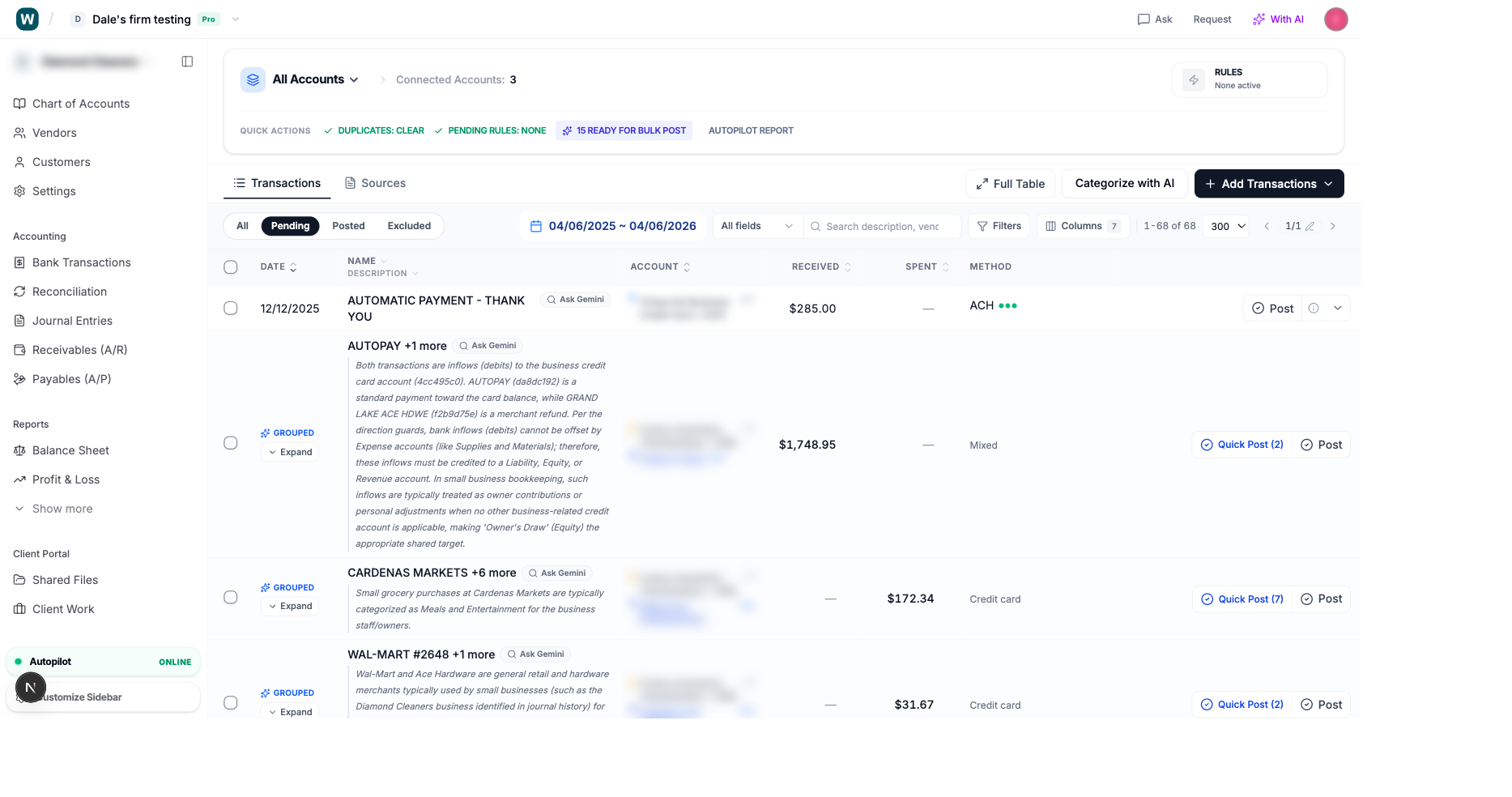
That changes the work from endless micro-decisions into a smaller number of higher-confidence approvals. It is a better use of reviewer attention, and it reduces the kind of repetitive work that makes tax-season weeks feel longer than they are.
This is one of the clearest ways Wesley helps reduce accountant burnout without lowering review quality.
Stop exception cleanup from hijacking senior staff time
The other burnout driver is exception cleanup. Not every transaction should be auto-posted. But firms also should not force senior staff to babysit every unresolved check or ambiguous memo line.
Wesley splits true exceptions into dedicated workflows instead of mixing them into the normal posting stream. On the Generic checks page, unresolved items are isolated and the team can either resolve them directly or send them out for clarification.
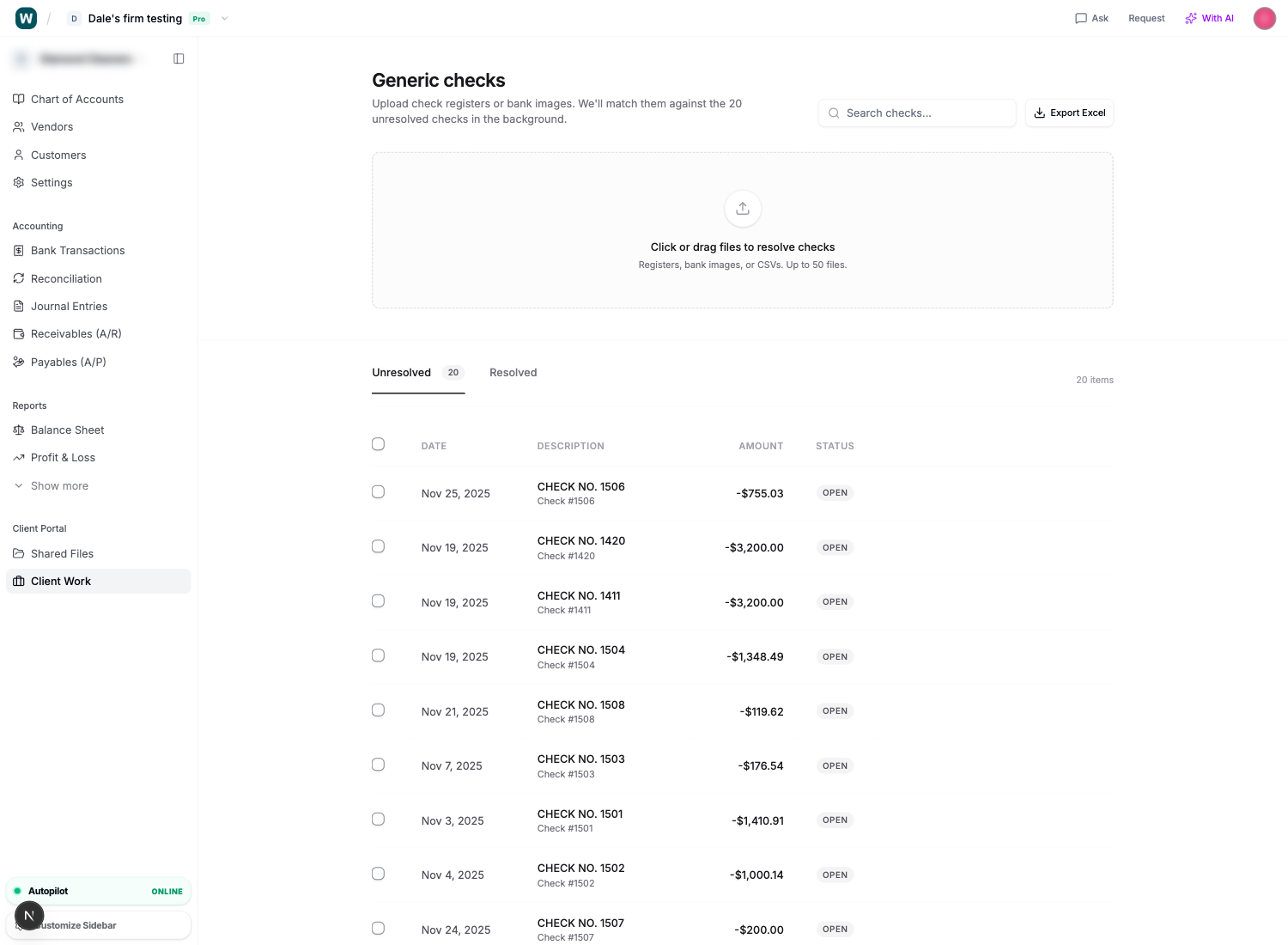
That matters because it protects focus. Instead of forcing the whole team to constantly switch between normal categorization and oddball cleanup, Wesley makes exceptions explicit. Teams can batch them, delegate them, and keep the normal flow moving.
For firms searching bookkeeping burnout or reduce burnout in accounting firms, this is a practical point: burnout often comes from exceptions being everywhere, not just from having exceptions at all.
Keep client follow-up in one queue instead of scattered threads
Client chasing is one of the most demoralizing parts of bookkeeping work. The hard part is not sending a question. The hard part is remembering what was asked, what came back, and what still blocks the books.
Wesley keeps those requests in Client Work so the team can see open questions, selected issue details, and the next action in one place.
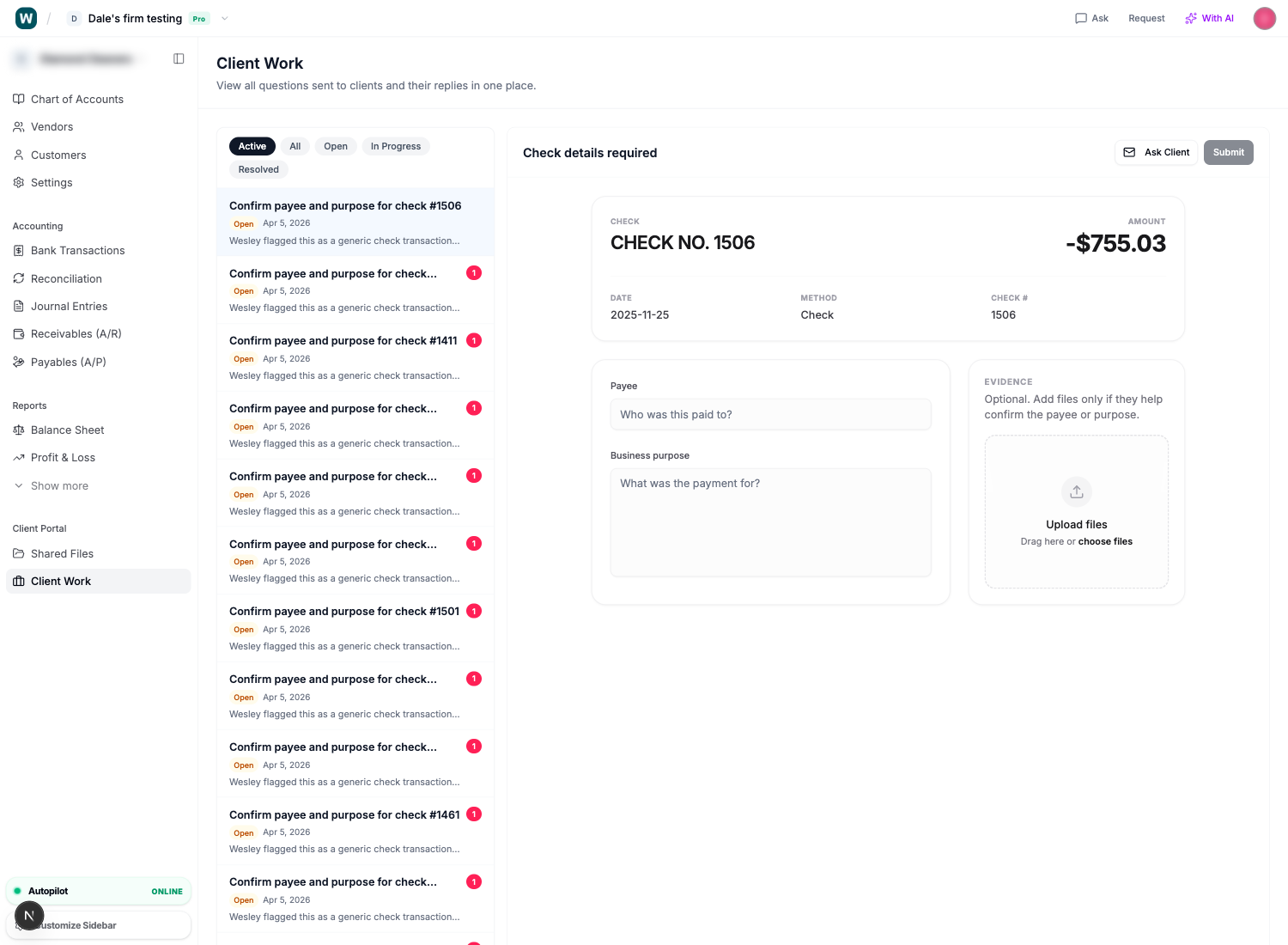
That changes the day-to-day experience for the firm:
- staff do not have to remember which client got asked what
- reviewers can see whether a missing answer is still blocking close
- evidence and explanations stay tied to the work item
- the team can work from a queue instead of from inbox memory
Wesley is especially useful here because it gives the firm a structured place to ask clients for missing context without letting that process disappear into scattered follow-up threads.
A lower-burnout workflow for accounting firms
If your firm is trying to reduce burnout without simply hiring more people, the better play is usually to remove the work patterns that create fatigue.
A healthier accounting workflow looks more like this:
- monitor backlog at the portfolio level so overload is visible early
- use grouped suggestions and bulk posting for repeatable transaction patterns
- isolate true exceptions instead of mixing them into the normal queue
- ask clients only for the items that genuinely need outside context
- keep client questions and replies in a shared work queue
- let seniors spend more time reviewing outcomes and less time doing administrative triage
That is the operating model Wesley is built to support. The goal is not to make busy season disappear. The goal is to stop wasting staff energy on work the system should structure for them.
Why this matters for tax season, month-end close, and retention
Accounting firm burnout is not just a people problem. It becomes a margin problem and a client-service problem.
When a team is overloaded:
- close cycles slow down
- review quality gets less consistent
- managers spend more time firefighting
- client communication gets more reactive
- good staff start thinking about leaving
That is why a lot of the real search intent behind CPA burnout, accountant burnout, and tax season burnout accounting is actually about systems. Firms want to protect output and staff capacity at the same time.
With Wesley, the path is operational: make the queue visible, reduce one-by-one categorization, isolate exceptions, and centralize client follow-up.
FAQ: accounting firm burnout
What causes burnout in accounting firms?
Usually a combination of high volume, fragmented workflows, repetitive transaction review, client chasing, and poor visibility into what is actually blocking close.
How can accounting firms reduce burnout without hiring more staff?
The strongest lever is workflow structure. Firms reduce burnout when they group repeat work, centralize follow-up, surface backlog early, and stop asking senior staff to manually triage every exception.
Can automation reduce accountant burnout?
Yes, if the automation changes the day-to-day workflow instead of just adding another dashboard. The biggest wins come from grouped suggestions, bulk actions, and clear exception handling.
How does Wesley help reduce burnout for accounting firms?
Wesley helps firms see portfolio backlog, group and bulk post repeatable transactions, separate unresolved checks and other exceptions, and keep client questions in a shared work queue.
Final takeaway
If your team is searching for accounting firm burnout, accountant burnout, or how to reduce burnout in accounting firms, the answer is rarely another reminder to work harder or be more resilient.
The better answer is to design a bookkeeping workflow that creates fewer unnecessary decisions, fewer hidden queues, and fewer scattered follow-ups.
With Wesley, firms can turn backlog visibility, grouped transaction handling, exception workflows, and client work queues into a more sustainable delivery model. That is how you reduce burnout without slowing the books down.
Build a calmer filing workflow
Keep contractor docs, payment exceptions, and follow-ups tied to the actual work
Wesley is strongest when the filing problem is really a workflow problem: missing documents, unclear payment channels, and last-minute cleanup before you can trust the numbers.
Related reads
Discover adjacent articles without being sent to near-duplicate topics.